Defining the Role of a Low Loss Header 40kw in Modern Systems
In modern hydronic system design, achieving hydraulic equilibrium is paramount to preventing pump conflict and ensuring that variable speed drives can operate within their intended parameters. A low loss header 40kw acts as a neutral point in the system, allowing the primary boiler circuit and the secondary heating circuits to operate independently of one another. For smaller commercial applications, such as boutique offices or community centres, the integration of a low loss header 40kw provides the necessary buffer to manage flow rate discrepancies. Without this decoupling, the primary pump may struggle against the resistance of the secondary zones, leading to premature component failure and inefficient heat transfer across the boiler heat exchanger.
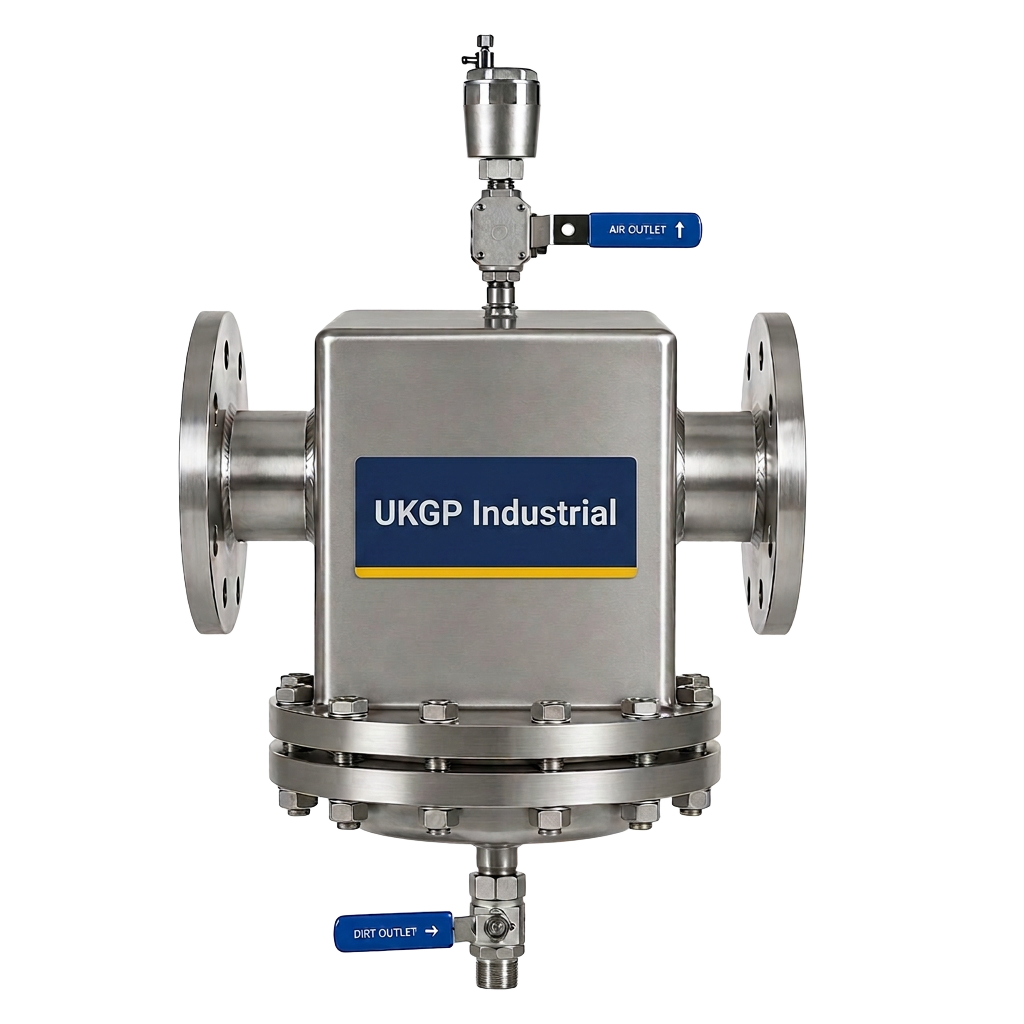
When specifying a low loss header 40kw, engineers must consider the internal velocity of the fluid to ensure that sediment can drop out and air can be effectively vented. By creating a zone of low pressure and low velocity, the header allows for the collection of debris, which aligns with the maintenance recommendations outlined in BSRIA BG29 for pre-commissioning cleaning and BG50 for water treatment in closed systems. The UKGP range of headers is designed to facilitate this process, providing a central point for air and dirt removal while maintaining the 40kW thermal throughput required by the system design. This ensures that the high-efficiency condensing boilers used in today's UK commercial market can operate at their peak performance levels without hydraulic interference.
Choosing UKGP Industrial for your hydraulic separation needs provides peace of mind through British-engineered quality and rapid availability. Our units are manufactured to provide a reliable interface for systems requiring a low loss header 40kw, featuring robust construction that withstands the rigours of a busy commercial plant room. By decoupling the circuits, you effectively protect the boiler's delicate heat exchanger from the varying pressure drops of the secondary system. This is particularly critical in retrofit scenarios where old pipework may have high resistance or inconsistent flow patterns. Our headers bridge that gap, ensuring a stable and predictable environment for the heat source to function.
- Ensures total hydraulic separation between primary and secondary circuits.
- Reduces pump wear by eliminating competing flow velocities.
- Facilitates easier system balancing and commissioning for M&E contractors.
- Includes high-quality insulation jackets to minimise standing heat losses.
Hydraulic Sizing and Flow Rate Calculations
Correct sizing of a low loss header 40kw is not merely about the kilowatt rating; it is fundamentally about the flow rate (m³/h) and the temperature differential (ΔT) of the system. In a typical heating circuit with a ΔT of 20°C, a 40kW load requires a flow rate of approximately 1.72 m³/h. If the system is designed for a narrower ΔT, such as 10°C, the required flow rate doubles, necessitating a header that can handle nearly 3.5 m³/h without exceeding the recommended internal velocity of 0.5 m/s. Specifying a low loss header 40kw necessitates a careful review of these variables to prevent turbulence and ensure that the neutral zone remains effective under all load conditions.
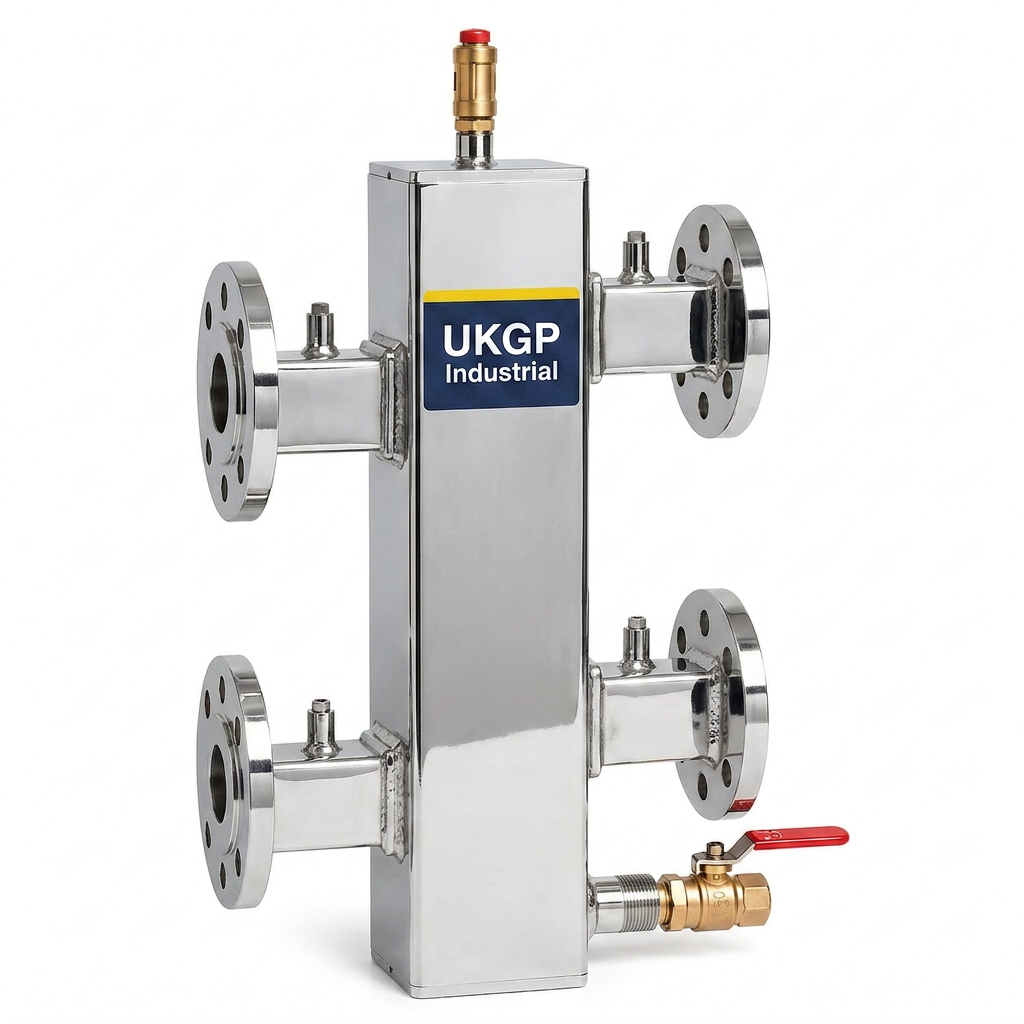
The physical dimensions of the header play a vital role in its performance. A header that is too small for its intended flow will fail to decouple the circuits effectively, leading to 'carry-over' where the primary pump influences the secondary circuits. Conversely, an oversized unit may lead to excessive thermal lag and unnecessary cost. The UKGP commercial 40-2000 kW range provides a spectrum of sizes to match exact project requirements. For a low loss header 40kw, we offer both flanged and threaded (BSP) connections, allowing for flexible installation in various plant room layouts. Each unit is pressure tested to ensure it meets the stringent safety standards required by UK building services consultants.
In addition to flow management, the low loss header 40kw serves as a vital point for air and dirt separation in accordance with CIBSE guidelines. By slowing the water velocity as it enters the larger diameter of the header, suspended solids are encouraged to settle at the bottom of the vessel for blowdown, while air bubbles rise to the top for venting through an automatic air vent. This dual functionality is essential for maintaining water quality and preventing the accumulation of magnetite, which is the leading cause of heat exchanger failure and circulating pump damage. Integrating a UKGP header ensures your plant room meets these critical longevity milestones.
- Internal velocity should generally not exceed 0.5 metres per second.
- Calculate flow rates based on the specific ΔT of the proposed heating loops.
- Ensure the header diameter is at least three times the diameter of the inlet pipes for optimal decoupling.
- Available in BSP threaded or PN16 flanged options to suit the pipework specification.
Material Specifications and Compliance Standards
Material integrity is a non-negotiable aspect of commercial building services. A low loss header 40kw from UKGP Industrial is manufactured using high-grade carbon steel or stainless steel, depending on the specific application and water chemistry requirements. Our vessels are designed to exceed the life expectancy of the boilers they serve, providing a 2-year warranty as standard. When combined with our range of expansion bellows, which are manufactured to BS EN 14917 standards, the header becomes part of a resilient and thermally flexible pipework network that can handle the stresses of frequent cycling and thermal expansion typical in modern commercial buildings.
The use of a low loss header 40kw is often mandated by major UK commercial boiler OEMs to protect their equipment and validate warranties. Because these headers provide a dedicated point for the installation of temperature sensors (to monitor secondary flow), they allow the building management system (BMS) to accurately modulate the boiler output based on actual demand. This level of control is essential for achieving the efficiency targets set out in Part L of the Building Regulations. UKGP's commitment to quality ensures that every header, including the 40kw variant, is supplied with a high-performance insulation jacket to prevent energy wastage from the plant room into unoccupied spaces.
Furthermore, our manufacturing process adheres to the highest UK standards, ensuring that each low loss header 40kw is ready for immediate site integration. With a lead time of just 2-3 weeks, we support contractors in meeting tight project deadlines without compromising on the technical specification. Whether your project requires a compact 1" BSP unit or a larger flanged DN50 solution for a low loss header 40kw application, our team provides the technical submittals and CAD blocks necessary for modern BIM workflows. This professional documentation is essential for consultants who must prove compliance with BS 8552 regarding the sampling and monitoring of water within the system.
- Complies with all relevant UK pressure equipment regulations.
- Supplied with bespoke insulation jackets to meet energy efficiency standards.
- Rigorous factory pressure testing at 1.5 times the working pressure.
- Compatibility with a wide range of secondary distribution pumps.
Installation Best Practices for the Low Loss Header 40kw
Successful installation of a low loss header 40kw begins with correct orientation. For the majority of commercial applications, a vertical mounting is preferred to maximise the benefits of thermal stratification and to allow the integrated air and dirt separation features to function correctly. The primary flow from the boiler should enter at the top of the header, while the secondary flow to the heating circuits should be taken from the opposite side at a similar level. This configuration ensures that the hottest water is always available to the zones requesting heat, while the cooler return water sinks to the lower portion of the header before returning to the boiler for reheating.
When installing a low loss header 40kw, it is vital to provide sufficient clearance for maintenance activities. This includes space to access the drain valve at the bottom for regular flushing of settled solids and access to the top for the inspection of the automatic air vent. Contractors should also ensure that the header is adequately supported, as the weight of the unit when full of water can be significant. UKGP Industrial provides robust mounting brackets and supports designed to take the load off the pipework, thereby reducing the risk of stress fractures and leaks over the system's operational lifespan.
Finally, the integration of a pocket for a temperature sensor within the low loss header 40kw cannot be overlooked. This sensor provides the boiler controller with the 'common flow' temperature, which is the most accurate reflection of system demand. When the secondary circuits are satisfied and the zone valves close, the header allows the primary flow to bypass directly back to the boiler, signalling the burner to modulate down or shut off. This prevents short-cycling, a major cause of energy waste and mechanical wear. Contact UKGP today for a quote on our 40kw headers to ensure your next project benefits from this level of precision control.
- Mount vertically to allow for effective air venting and dirt catchment.
- Install a drain valve at the base for BSRIA-compliant sludge removal.
- Position temperature sensors in the provided pockets for accurate BMS feedback.
- Check all threaded or flanged connections for alignment before final tightening.
Protecting the System with Advanced Pipework Components
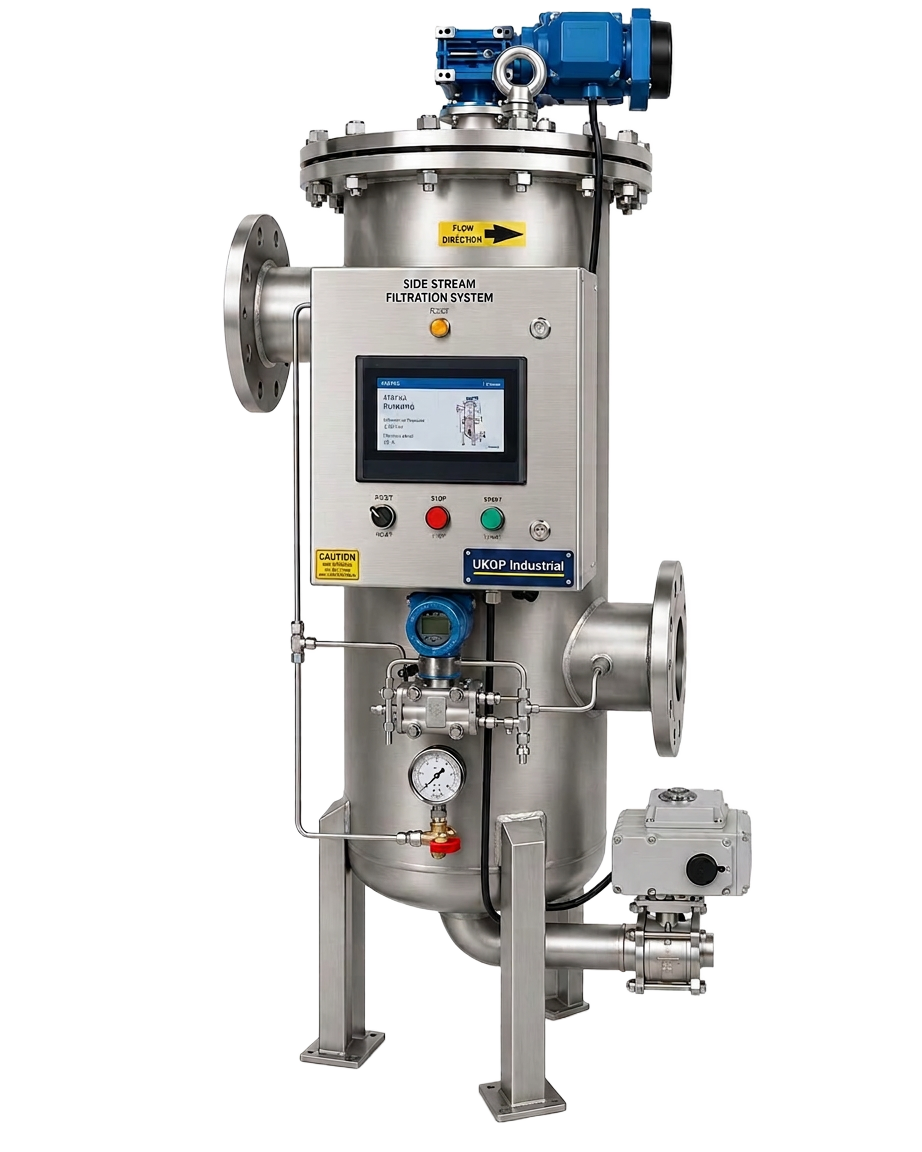
While the low loss header 40kw manages hydraulic separation, it is often complemented by other essential plant room components to ensure total system health. For instance, in systems where fine particulate matter is a concern, installing a side stream filtration skid alongside the header can provide a secondary level of protection by continuously cleaning a percentage of the system volume. This is particularly relevant in older buildings where the introduction of a new low loss header 40kw might disturb existing deposits. By combining these technologies, facility managers can achieve the water quality standards required for long-term operational efficiency and reduced maintenance costs.
Environmental monitoring is another critical aspect of modern plant room management. Monitoring the pH levels and conductivity of the water circulating through the low loss header 40kw can provide early warning signs of corrosion or microbiological activity. Integrating pH sensors and transmitters into the pipework allows for real-time alerting, ensuring that water treatment chemicals—often introduced via a dedicated dosing pot—are maintained at the correct concentrations. This holistic approach to system design, which includes the specified header and these auxiliary components, ensures the 40kW heating system remains reliable and cost-effective throughout its 20+ year lifecycle.
UKGP Industrial stands at the forefront of providing these integrated solutions to the UK market. Our low loss header 40kw is just one part of a wider portfolio designed to meet the exacting needs of BSRIA BG50 compliance. By sourcing your headers, separators, and expansion joints from a single UK-based manufacturer, you simplify procurement and ensure that all components are technically matched for compatibility. Our 2-3 week lead times and 2-year warranties apply across our commercial range, giving you the confidence to specify UKGP for even the most demanding building services projects in London, Surrey, and across the UK.
- Combine headers with side stream filtration for superior water clarity.
- Integrate pH monitoring to prevent corrosion within the heat exchanger.
- Use high-quality dosing pots for precise chemical treatment delivery.
- Ensure all auxiliary components are rated for the same system pressure and temperature.
The Commercial Advantage of Specifying UKGP Industrial
For procurement leads and M&E contractors, the choice of a low loss header 40kw often comes down to a balance of technical performance, lead time, and cost. UKGP Industrial bridges this gap by offering British-made quality with the agility of a local supplier. Our internal engineering team is available to assist with sizing queries, ensuring that the low loss header 40kw you order is the correct fit for the calculated flow rates of your project. This level of technical support is invaluable when navigating the complexities of modern HVAC design, where incorrect sizing can lead to expensive site remediations and system downtime.
Our low loss headers are designed with the installer in mind, featuring accessible ports and clear identification markings. The inclusion of a 2-year warranty on every low loss header 40kw demonstrates our confidence in the longevity of our products. In a market where imported alternatives can have fluctuating lead times and uncertain material provenance, choosing a Surrey-based manufacturer like UKGP provides a significant commercial advantage. We understand the UK building regulations and CIBSE recommendations, ensuring that our products help you achieve a compliant and high-performing heating installation every time.
To request a technical datasheet or a competitive quotation for a low loss header 40kw, please contact our sales office. We provide solutions for systems ranging from 40kW up to 2000kW, with options for PN16 flanged or BSP threaded connections to suit any commercial pipework standard. With our commitment to short lead times and robust engineering, UKGP Industrial is the preferred partner for UK building services professionals seeking reliable hydraulic separation and air/dirt removal solutions. Enhance your system's efficiency and protect your plant room investment with a UKGP header today.
- Short 2-3 week lead times for standard commercial variants.
- Expert technical support based in the UK for sizing and selection.
- Robust 2-year warranty provided on all low loss header units.
- Comprehensive documentation provided for O&M manuals and BIM compliance.
Frequently asked questions
What is the primary function of a low loss header 40kw?
- The primary function is to decouple the primary boiler circuit from the secondary heating circuits, ensuring that flow rates in either circuit do not negatively impact the other. This prevents pump conflict and protects the boiler heat exchanger.
Can a low loss header 40kw be used for larger systems?
- A 40kw header is specifically sized for systems with a 40kW thermal output. For larger requirements, UKGP offers a full range of headers up to 2000kW to ensure correct hydraulic separation for any commercial application.
What connection types are available for the low loss header 40kw?
- UKGP provides these units with either BSP threaded connections for smaller installations or PN16 flanged connections for a more robust, industrial-grade seal, depending on your pipework specification.
How does the header help with BSRIA BG50 compliance?
- The low loss header 40kw acts as a low-velocity zone where air can be vented and dirt can settle. This supports the water quality and maintenance standards set out in BSRIA BG50 for managing closed-circuit heating systems.
Is insulation included with the UKGP low loss header 40kw?
- Yes, every UKGP low loss header is supplied with a high-quality insulation jacket as standard to minimise standing heat losses and ensure compliance with building energy efficiency regulations.