Defining the Low Loss Header and its Core Function
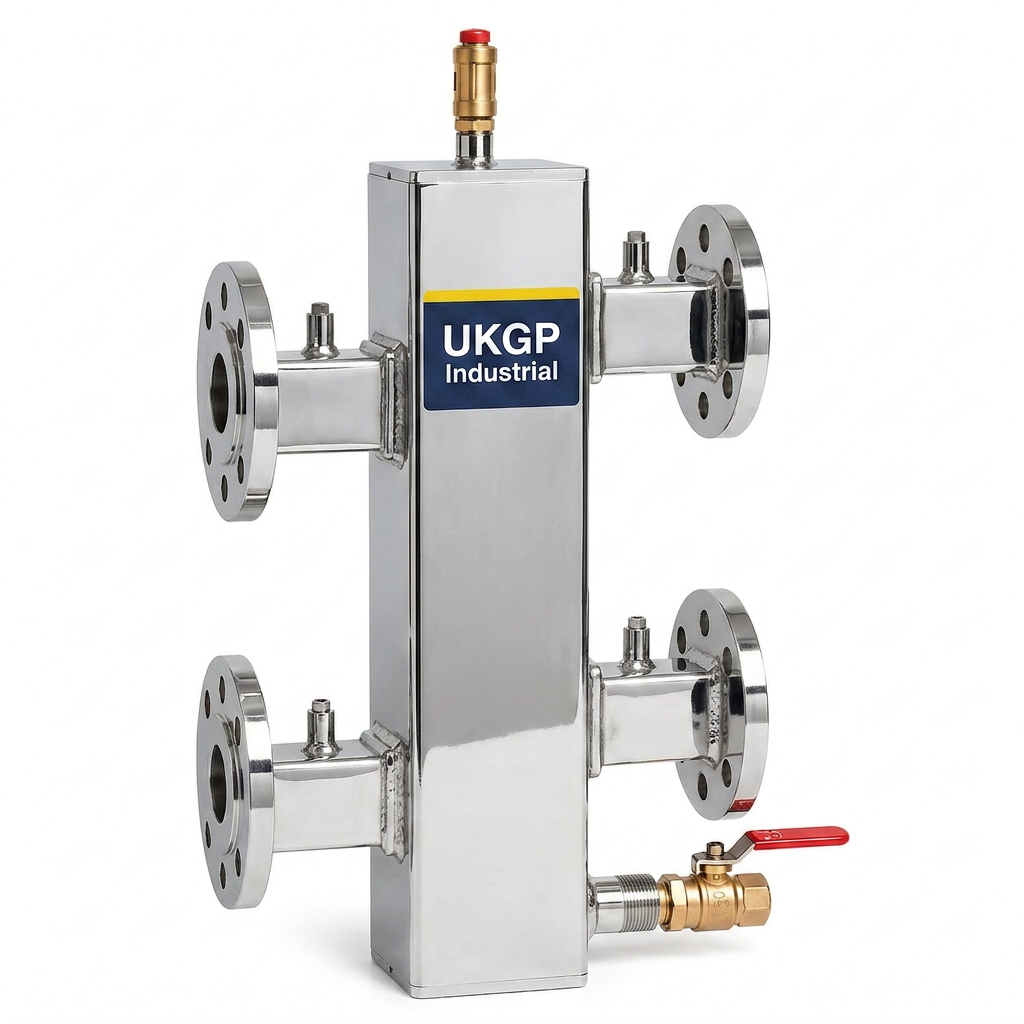
A low loss header is a chamber—typically a vertical or horizontal rectangular or cylindrical vessel—designed to act as a neutral point of pressure in a hydronic system. In UK commercial plant rooms, it is the standard method for connecting multiple boilers (such as those from leading UK boiler OEMs) to a variable flow distribution system. Its primary role is hydraulic separation, ensuring that the flow rates in the primary circuit (the boilers) do not adversely affect the flow rates in the secondary circuit (the heating emitters).
Without a low loss header, the pumps in the distribution circuit would 'pull' or 'push' through the boiler circuit, potentially causing flow rates through the heat exchanger to exceed or fall below manufacturer specifications. This leads to inefficient combustion, increased wear on pump components, and 'hunting' within controlled valves. By providing a neutral zone where the pressure drop is effectively zero, the LLH allows each pump to operate according to its own curve and control logic.
The term 'low loss' refers to the minimal pressure drop across the vessel itself. For a header to function correctly, the internal diameter must be significantly larger than the connecting pipework. This reduction in velocity allows for the fluid to redistribute its kinetic energy, ensuring that the delta-T (temperature difference) across the primary and secondary connections remains stable and predictable.
- Decouples the primary (source) circuit from the secondary (load) circuit.
- Maintains a point of zero pressure drop, preventing pump conflict.
- Facilitates air and dirt separation through reduced flow velocity.
- Allows for variable flow on the secondary side while maintaining constant flow on the primary side.
Hydraulic Separation Principles and Flow Dynamics
The physics of a low loss header are governed by the relationship between the primary flow (Qp) and secondary flow (Qs). In modern systems using modulating pumps and TRVs, Qs is rarely constant. If the secondary pump is pulling more water than the boilers are providing (Qs > Qp), some of the cooler return water from the system is drawn back up the header and mixed with the hot flow from the primary. This lowers the flow temperature to the emitters, which must be accounted for in the design stage.
Conversely, if the boilers are producing more flow than the system requires (Qp > Qs), the excess hot water bypasses the distribution circuit and returns directly to the boilers. This is a common scenario in modern condensing boiler plant. However, if the return temperature rises too high (above 55°C), the boilers may cease to condense, significantly dropping the overall plant efficiency. Engineers must therefore balance the desire for hydraulic separation with the need for condensing performance.
The internal velocity of the water within the header is the critical design metric. To ensure a 'dead zone' where pressure is neutral, the vertical velocity within the header should generally not exceed 0.1 to 0.2 m/s. This ensures that the momentum of the water entering the header does not carry it directly across to the opposite outlet, but instead allows it to mix or bypass as required by the pressure differentials.
- Primary Flow > Secondary Flow: Mixing occurs, raising return temperature to boilers.
- Secondary Flow > Primary Flow: Mixing occurs, lowering flow temperature to the load.
- Primary Flow = Secondary Flow: Ideal equilibrium (rarely achieved in variable systems).
Calculating and Sizing the Low Loss Header
Sizing a low loss header based solely on pipe connection size is a common but dangerous error in commercial M&E procurement. Correct sizing must be based on the maximum potential flow rate of the system (typically the larger of the primary or secondary flow). The UK industry standard, often referenced in CIBSE AM14, suggests that the velocity within the header should be kept extremely low to ensure hydraulic decoupling.
To calculate the required cross-sectional area, find the maximum flow rate in m³/h and divide it by the design velocity (usually 0.1 m/s for high-performance headers). For example, a 500kW system with a 20°C delta-T requires approximately 21.5 m³/h. At a design velocity of 0.1 m/s, the header requires a cross-sectional area that equates to a much larger diameter than the DN80 or DN100 pipework usually found on such systems.
Furthermore, the spacing of the nozzles is vital. To prevent 'short-circuiting'—where water shoots across the header from the flow inlet to the flow outlet without mixing—the nozzles are often staggered or spaced at a distance equivalent to at least four times the header diameter. UKGP Industrial headers are engineered with these ratios in mind to ensure that the neutral zone is maintained even under peak load conditions.
Integrated Air and Dirt Separation
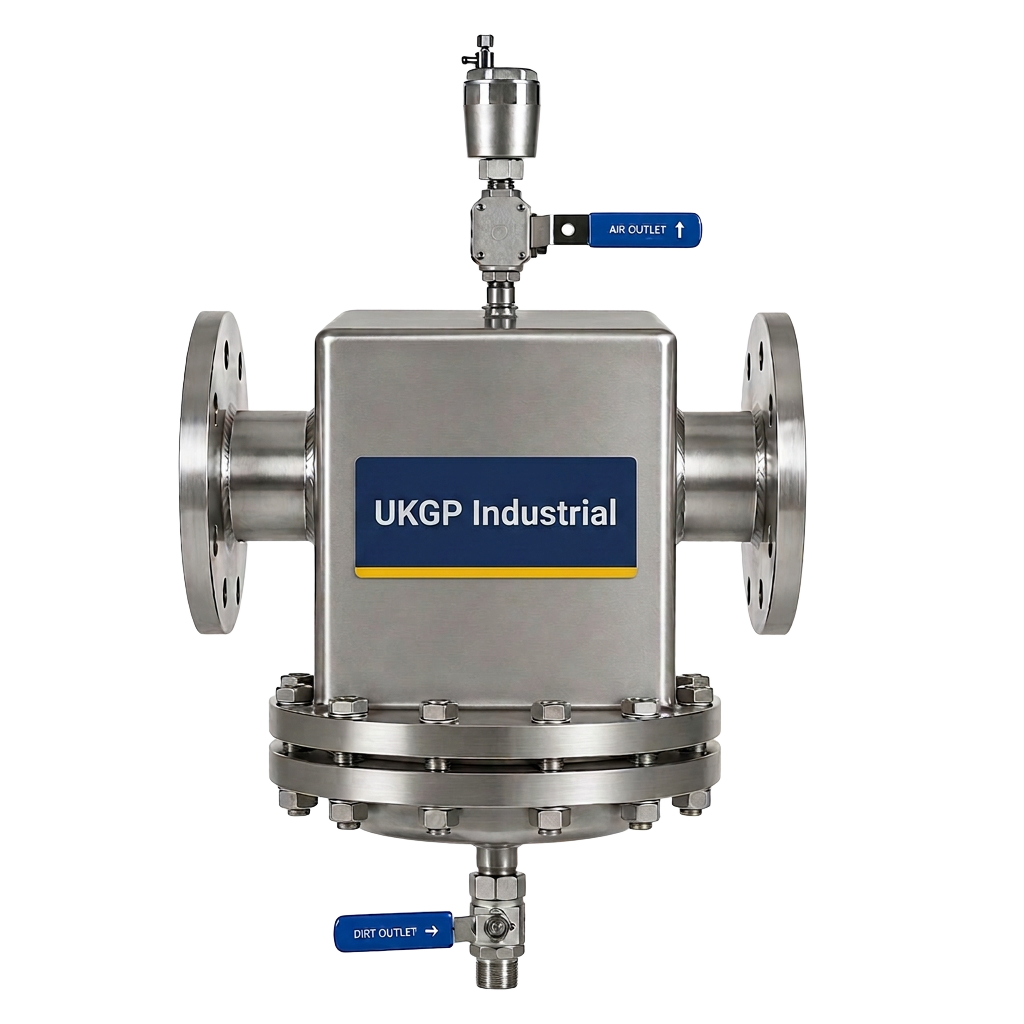
In many modern plant room configurations, the low loss header doesn't just provide hydraulic separation; it also acts as a primary point for air and dirt removal. Because the velocity of the water drops significantly as it enters the larger volume of the header, heavy particles (magnetite, scale, and welding slag) naturally fall out of suspension. Similarly, microbubbles of air rise to the top of the vessel.
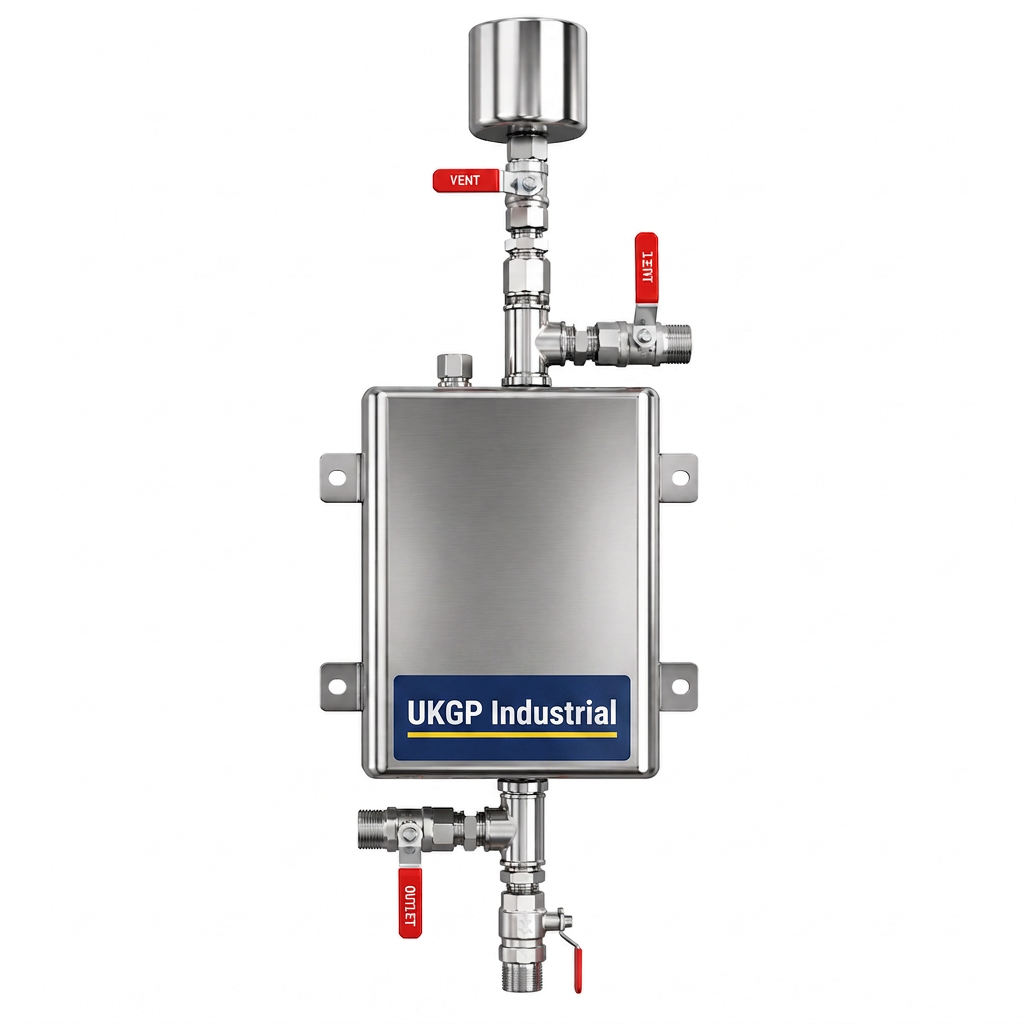
Standard practice now often involves specifying '4-in-1' headers which include an internal baffle or magnetic insert. While a dedicated air and dirt separator is often used in conjunction with an LLH, high-quality headers will include a drain valve at the lowest point for sludge removal and an automatic air vent (AAV) at the highest point. This is particularly important for protecting the small-bore waterways in modern high-efficiency heat exchangers from modern commercial boiler OEMs.
BSRIA BG50 (Maintenance of Water Quality) highlights the importance of managing suspended solids to prevent erosion and corrosion. By slowing the water down within the LLH, engineers take advantage of the 'settling tank' effect. However, for systems with high concentrations of magnetite, the addition of a dedicated magnetic separator is highly recommended to supplement the header’s internal features.
- Compliance with BSRIA BG29/21 regarding system cleanliness.
- Reduction in maintenance costs by protecting boiler heat exchangers from debris.
- Improved heat transfer efficiency across the entire system.
The Role of the LLH in Condensing Boiler Plant
Condensing boilers achieve their high efficiency (often >100% net) by recovering latent heat from flue gases, a process that only occurs when the return water temperature is below the dew point (approx. 54°C for natural gas). A poorly designed or oversized low loss header can cause 'thermal bypass', where hot flow water mixes with return water, raising the temperature of the water entering the boiler and preventing condensation.
To mitigate this, many UK consultants are moving toward 'low temperature hot water' (LTHW) designs with a 20°C differential (e.g., 70/50°C or 60/40°C). In these scenarios, the low loss header must be precision-managed. If the primary flow is higher than the secondary flow, the return temperature rises. Advanced control strategies, such as Weather Compensation or 0-10V boiler modulation, are used to ensure the primary flow rate matches the secondary demand as closely as possible, keeping the header in 'equilibrium' or 'consumer-led' mode.
Where multiple boilers are installed in a cascade, the low loss header provides a common return point. This ensures that even if only one boiler is firing, the hydraulic integrity of the rest of the system is not compromised. It allows for the 'lead' and 'lag' boilers to be rotated or modulated based on a single sensor reading taken from the header itself, often referred to as the 'common flow sensor'.
- Low-mass heat exchangers require guaranteed minimum flow to prevent boiling or thermal stress.
- Secondary variable speed pumps (VSD) can vary flow from 10% to 100%.
- Primary pumps are often integrated into the boiler or managed by a dedicated cascade controller.
Installation Considerations and Orientation
The orientation of a low loss header is usually vertical. This is not purely for space-saving reasons; it encourages thermal stratification. In a vertical header, the hottest water naturally resides at the top, while the cooler, denser return water stays at the bottom. This stratification helps prevent the immediate mixing of flow and return currents, allowing the system to maintain a more consistent temperature profile.
In horizontal installations, the bypass effect still works hydraulically, but the benefits of stratification are largely lost. If a horizontal header must be used—perhaps due to ceiling height constraints in a basement plant room—engineers must be extra vigilant regarding the internal baffle design and ensure the length is sufficient to prevent turbulence. Connection sizes must be correctly aligned, typically with the boiler flow and system flow at the top, and boiler return and system return at the bottom.
Insulation is another non-negotiable factor. Because the low loss header contains a significant volume of heated water, it can act as a giant radiator if left bare. Bespoke EPP (Expanded Polypropylene) or mineral wool jackets should be used to meet Part L of the Building Regulations. Uninsulated headers are a major source of 'unmanaged heat loss' in commercial plant rooms, often leading to overheating of the plant room environment.
- Vertical: Saves floor space and aids in natural stratification.
- Horizontal: Useful in plant rooms with height restrictions or for specific modular boiler skids.
- Cylindrical: Typically used for higher pressure ratings and larger industrial capacities.
- Rectangular: Common for medium-sized commercial applications where compact foot-print is required.
Materials, Connections, and Technical Specifications
In the UK, most low loss headers are manufactured from carbon steel (S235JR or similar) and finished with a protective coating to prevent external corrosion. For specialist applications, such as those in the food and beverage industry or where aggressive water chemistry is a concern, stainless steel variants (Grade 304 or 316) are available. The material choice must reflect the design life of the plant, typically 25 years for commercial installations.
Connection types generally follow the standards of the rest of the pipework. In plant rooms where boilers like high-capacity commercial boilers are used, flanged PN16 connections are the industry standard. For smaller commercial installations (under 70kW), threaded connections may be acceptable. The header must also include tapping points for temperature sensors (thermowells) and pressure gauges to allow for system commissioning and performance monitoring.
Pressure ratings must be strictly adhered to. While most LTHW systems operate at 3 bar to 6 bar, some high-rise or industrial process systems require headers rated for 10 bar or even 16 bar. It is essential that the LLH is pressure tested (typically to 1.5x working pressure) prior to dispatch, ensuring compliance with the Pressure Equipment Directive (PED). UKGP Industrial headers are manufactured to these rigorous standards, ensuring safety and reliability.
- Screwed (BSPT/NPT) for smaller systems up to 2".
- Flanged (PN16/PN25) for commercial and industrial pipework.
- Victaulic / Grooved for faster installer-side labour.
Choosing the Right Header for Modern Systems
When selecting a low loss header, the consultant must look beyond simple kW ratings to the volumetric flow and the intended delta-T. As modern systems move toward lower operating temperatures for heat pump integration or high-efficiency condensing, the requirements for hydraulic separation become more nuanced. A header that worked for an 82/71°C system may be entirely unsuitable for a modern 60/40°C system due to the higher flow rates required for the same heat transfer.
BMS (Building Management System) integration is also a key factor. A header with multiple sensor pockets allows for the monitoring of the primary flow, secondary flow, and the bypass temperature. This data is invaluable for local control logic, allowing the boilers to adjust their output based on the actual 'mixing' occurring within the header, rather than just the boiler's internal sensor.
Ultimately, a well-engineered low loss header is an insurance policy for the plant room. It protects the most expensive components—the boilers or chillers—from hydraulic stress, debris, and inefficient operation. Whether scaling up a small commercial office or designing a complex multi-megawatt district heating system, the principles of low-velocity hydraulic separation remain the cornerstone of a balanced, efficient hydronic circuit. By following BSRIA and CIBSE recommendations and using high-quality components, UK engineers can ensure their designs perform as expected for decades.
- Air and dirt separation in one unit.
- Pre-drilled sensor pockets for BMS integration.
- Optimised internal geometry to prevent turbulence.
Frequently asked questions
What is the difference between a low loss header and a buffer tank?
- A low loss header relies on a very low pressure drop (effectively zero) to allow primary and secondary pumps to operate independently. A buffer tank is designed to provide thermal mass and store energy, specifically to prevent short-cycling in heat pumps or biomass systems. While similar in appearance, their hydraulic functions differ.
Where should a low loss header be installed?
- Ideally, the LLH should be installed within the plant room, as close to the boilers as possible. This minimises heat loss from the bypass and ensures that the hydraulic neutrality of the plant-side circuit is maintained without excessive pipe friction.
Can a low loss header be used in chilled water systems?
- Yes, in cooling applications they are often referred to as 'decoupling headers'. The principle remains the same: ensuring the constant flow requirements of the chiller are met while the variable flow of the AHUs or fan coils varies according to demand.
What happens if a low loss header is undersized?
- Undersizing leads to high velocities (exceeding 0.5 m/s), which causes turbulent mixing. This prevents the header from achieving a stable temperature gradient and increases pressure drop, effectively negating the 'low loss' purpose and causing hydraulic interference between pumps.