The Role of a Moisture Separator For Air Compressor in UK HVAC
In commercial plant-rooms across the UK, managing condensate is a primary concern for mechanical and electrical contractors. A moisture separator for air compressor applications functions by removing liquid water and solid particulates from the compressed air stream, preventing these contaminants from reaching sensitive control valves or heat exchangers. Without this critical component, humidity within the pipework can lead to premature oxidation and microbial growth, which compromises the integrity of the heat transfer fluid or the air supply itself. Engineers must prioritise high-mechanical strength units that can withstand fluctuating pressures in busy industrial environments where downtime is commercially unacceptable.
When specifying a moisture separator for air compressor systems, it is vital to consider the flow rates and the specific grade of filtration required by your facility. Standard centrifugal separators are excellent for bulk liquid removal, but for complete system hygiene, a unit with integrated coalescing media is often preferred. This approach aligns with CIBSE guidelines on environmental control and energy efficiency by ensuring that the air remains dry and free from oil mist. This level of protection is essential for UK businesses that operate high-value machinery or rely on precision instrumentation that requires clean, dry compressed air to maintain manufacturer warranty compliance.
Furthermore, the integration of these separators helps to mitigate the risk of 'slugging'—a phenomenon where large volumes of water move through the pipework simultaneously. This can cause severe damage to low loss headers and other downstream components. By installing a robust moisture separator for air compressor setups, you are essentially creating a firewall for your pneumatic and thermal systems. Professionals should look for units that offer low pressure drops to ensure that the booster pumps or compressors are not working harder than necessary, thereby lowering the cumulative carbon footprint of the building services infrastructure in line with modern sustainability targets.
- Prevents internal pipework corrosion and pitting
- Reduces failure rates of pneumatic control actuators
- Supports CIBSE and BSRIA best practices for system cleanliness
- Minimises downstream maintenance on heat exchangers
Compliance with BSRIA BG29 and BG50 Standards
In the UK building services sector, compliance with BSRIA BG29 (Pre-commission Cleaning of Pipework Systems) and BG50 (Water Treatment for Closed Heating and Cooling Systems) is non-negotiable for high-specification projects. While these documents primarily focus on hydronic systems, the principle of early-stage contaminant removal remains identical for air-side applications. A high-grade moisture separator for air compressor units assists in maintaining the long-term health of the entire HVAC network. By capturing debris and moisture before they can circulate, building owners can ensure that the water and air volumes remain within the chemical and biological limits defined by the Association’s rigorous testing standards.
Ensuring that your air and dirt separation strategy is robust is a key requirement for modern M&E contractors. Proper separation avoids the buildup of magnetite and other metallic oxides that can thrive in moist environments. When a moisture separator for air compressor equipment is utilised effectively, it prevents these particulates from entering plate heat exchangers where they could cause significant blockages. Consulting engineers often demand documented evidence of separation efficiency during the commissioning phase. Adhering to these standards from the outset ensures that the building handover process is smooth and that the systems are resilient enough to survive decades of continuous operation without significant degradation.
Beyond initial installation, BG50 emphasises the importance of ongoing monitoring and maintenance. A moisture separator for air compressor systems should be easy to inspect and service. This is where integrated isolation kits and flanged connections prove their worth. By allowing engineers to isolate the unit for cleaning without draining the entire system, UK facilities managers can maintain compliance with BS 8552 for water sampling and system integrity. This proactive approach to asset management is favoured by procurement leads who are increasingly focused on Total Cost of Ownership (TCO) rather than just the initial capital expenditure for plant-room equipment.
- Facilitates compliance with BSRIA BG29 pre-commissioning cleaning
- Reduces biological growth risks in humid distribution networks
- Aligns with BG50 recommendations for closed-circuit protection
- Ensures long-term performance stability of commercial assets
Technical Specifications for Air and Dirt Separators
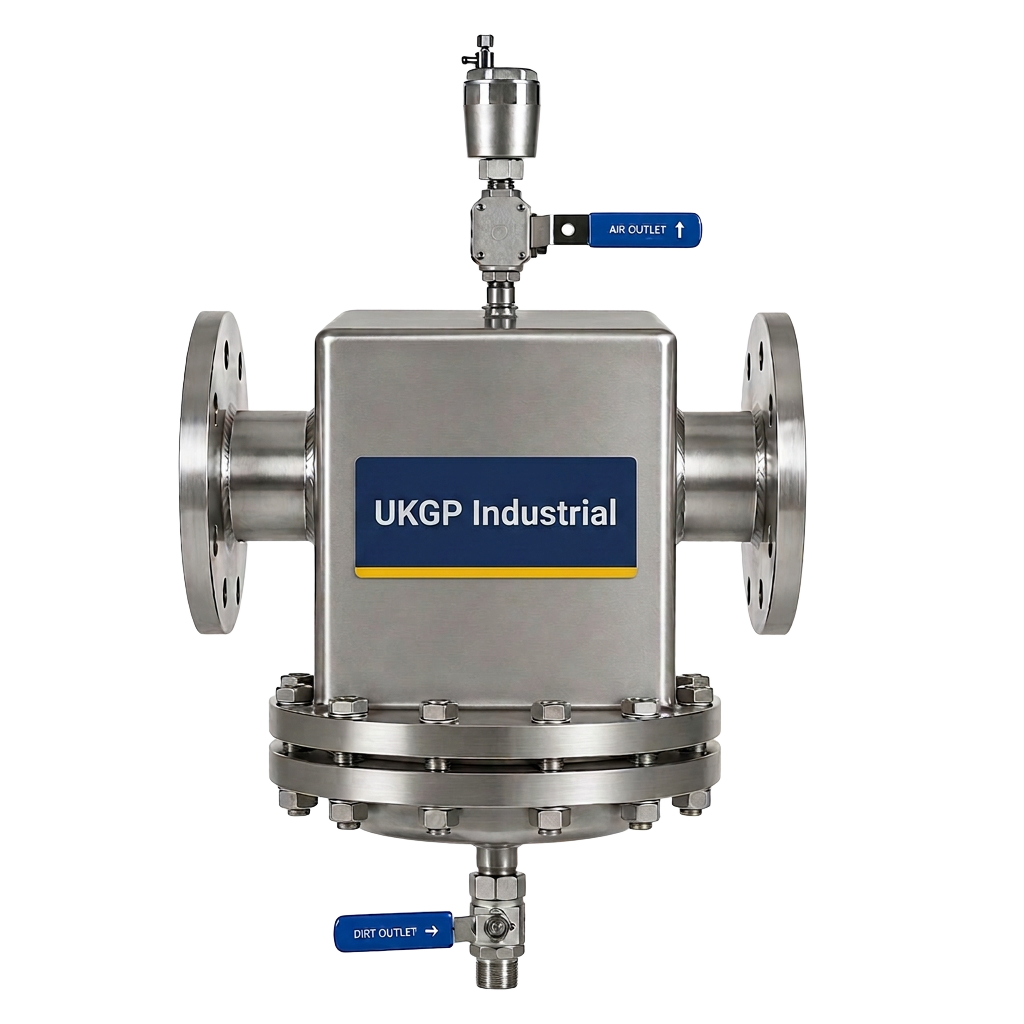
Selecting the right air and dirt separator involves more than just matching pipe diameters. Our range of UKGP air and dirt separators are designed for the most demanding commercial environments, featuring a combined coalescing media and magnetic catch to remove both micro-bubbles and magnetite particles. Available in sizes from DN25 to DN300, these units are flanged and rated for PN10/16 applications, providing the versatility required for diverse mechanical layouts. Each unit comes with a comprehensive isolation kit to simplify annual maintenance, ensuring that your moisture separator for air compressor strategy is supported by the highest quality hardware in the UK market today.
The inclusion of a magnetic catch is a critical differentiator for modern plant-rooms. Magnetite is one of the leading causes of pump failure and reduced heat transfer efficiency in the UK. By combining this with high-performance coalescing media, our separators capture even the smallest impurities that traditional filters might miss. This dual-action protection is essential for systems incorporating high-efficiency low loss headers or delicate chemical dosing pots. Furthermore, our 2-year warranty provides peace of mind for procurement teams and building owners, guaranteeing that the product is built to last under the pressures of 24/7 industrial or commercial operation.
Engineering excellence is at the heart of the UKGP design. Our separators are engineered to handle high flow rates while maintaining exceptional capture percentages for both air and solid dirt. Whether you are retrofitting an existing plant-room or designing a new-build energy centre, these units offer the structural integrity required to meet BS EN standards. We encourage consultants to specify the UKGP range to ensure that the moisture separator for air compressor functionality is complemented by superior dirt removal capabilities. Our technical team is available to provide CAD drawings and performance data to assist in the precise specification of your upcoming mechanical services project.
- Available in DN25-DN300 with flanged PN10/16 connections
- Dual-action coalescing media and magnetic catch technology
- Includes isolation kit as standard for easier servicing
- Supported by a 2-year manufacturer warranty for reliability
Integration with Expansion Bellows and Pipework
Mechanical movement and thermal expansion are significant factors in any compressed air or heating distribution network. When installing a moisture separator for air compressor units, it is vital to account for the stresses placed on the pipework. Expansion bellows, compliant with BS EN 14917, should be used to absorb these movements, ensuring that the separator connections are not subjected to excessive axial or lateral forces. A failure to account for thermal expansion can lead to leaks at the flange faces or even structural failure of the vessel. Integrating high-quality expansion joints ensures that the entire assembly remains airtight and structurally sound throughout its service life.
For UK building services engineers, the coordination between filtration units and expansion control is a hallmark of good design. In a busy plant-room, vibration from large compressors can transmit through the pipework, potentially loosening fittings or causing fatigue. By pairing a moisture separator for air compressor installation with properly specified anti-vibration expansion bellows, you create a more resilient and quieter system. This is particularly important in commercial residential buildings or hospitals where acoustic performance is a key KPI. UKGP provides a range of bellows that complement our filtration products, allowing for a single-source procurement route that simplifies logistics and technical support.
During the design phase, it is also recommended to consider the placement of pH sensors and transmitters. By removing moisture and debris through a high-quality separator, you ensure that any water remaining in the system is clean enough for accurate chemical analysis. Solid particulates can coat sensor electrodes, leading to drift or false readings in your water treatment monitoring system. Therefore, the moisture separator for air compressor acts as a primary filtration stage that supports the accuracy of your dosing and monitoring equipment. This holistic view of system health is what separates a standard installation from a high-performance commercial HVAC solution that delivers long-term value.
- Protects separator vessels from thermal expansion stress
- Reduces vibration transmission from heavy compressor machinery
- Ensures long-term flange integrity and prevents air leaks
- Accommodates axial, lateral, and angular pipework movement
Operational Efficiency and Energy Savings
Energy efficiency is a top priority for UK facility managers facing rising utility costs. A well-maintained moisture separator for air compressor systems contributes directly to energy savings by maintaining optimal pressure throughout the network. When moisture is allowed to accumulate, it can restrict flow and cause higher friction losses, forcing the compressor to consume more electricity to deliver the same output. By removing this moisture efficiently, the pressure drop across the system is minimised. This allows for a lower set-point on the compressor, which can result in significant annual savings on energy bills for large-scale industrial or commercial developments.
Furthermore, clean air prevents the fouling of internal surfaces in downstream equipment. In systems using plate heat exchangers for heat recovery from compressors, even a thin layer of scale or moisture-driven corrosion can drastically reduce thermal efficiency. Installing a moisture separator for air compressor protection ensures that these heat exchange surfaces remain clean, maximising the recovery of waste heat for space heating or domestic hot water. This interconnected approach to plant-room efficiency is a key strategy for achieving Net Zero targets in the UK built environment. Every percentage point gained in mechanical efficiency contributes to the overall sustainability of the facility.
Finally, the reduction in maintenance frequency cannot be overlooked. A system that is free from moisture and dirt requires fewer interventions from engineers, reducing the cost of replacement parts and chemical cleaning fluids. By specifying a combined air and dirt separator from UKGP, you are investing in a product that handles two critical tasks in a single vessel, reducing the footprint in often-crowded plant-rooms. To receive a bespoke quote for your project, contact our Surrey-based technical team today. We can help you select the exact DN size and flange rating to ensure your moisture separator for air compressor installation is perfectly matched to your system's operational requirements.
- Lowers compressor electricity consumption via reduced pressure drop
- Improves heat recovery efficiency for building services
- Reduces the need for frequent chemical system flushes
- Optimises the lifespan of high-value pneumatic components
Best Practices for Installation and Maintenance
To achieve the best results from a moisture separator for air compressor applications, correct positioning is essential. The unit should be installed at a point in the system where the air temperature has cooled sufficiently for moisture to condense into droplets, usually after the aftercooler. This ensures the coalescing media can effectively capture the bulk of the liquid. For hydronic systems, air separators should be placed at the point of lowest solubility—typically the hottest part of the system on the flow side. Following these placement rules ensures that the separator operates at its maximum theoretical efficiency, protecting the system from the first day of operation.
Maintenance should be scheduled in line with BSRIA recommendations, typically involving a monthly check of the magnetic catch and a visual inspection of the isolation kit. Because our UKGP separators feature inclusive isolation valves, engineers can quickly purge collected debris without a full system shutdown. This is a significant advantage for 24-hour facilities like data centres or hospitals where continuous operation is mandatory. Regularly clearing the moisture separator for air compressor contaminants prevents the buildup of sludge that could eventually bypass the filter. Documenting these maintenance steps is also crucial for insurance purposes and to maintain the 2nd-year portion of our product warranty.
Finally, always ensure that the discharge from the separator is handled correctly. In compressed air systems, the collected condensate may contain oil and must be passed through an oil-water separator before being discharged to the foul sewer, in compliance with UK environmental regulations. For heating and cooling systems, the dirt collected should be sampled to monitor for signs of internal corrosion, as part of a wider BS 8552 water quality management plan. By treating your moisture separator for air compressor as a critical data point for system health, you can move toward a predictive maintenance model that prevents failures before they happen, ensuring complete peace of mind for the building's stakeholders.
- Install after the aftercooler for maximum moisture capture
- Utilise the included isolation kit for zero-downtime cleaning
- Conduct regular sampling to verify internal system water quality
- Comply with UK environmental laws for condensate disposal
Frequently asked questions
What size moisture separator for air compressor do I need?
- Sizing is based on the maximum flow rate (m3/h) and the pipe diameter. UKGP offers units from DN25 to DN300. It is essential to ensure the separator can handle the peak flow without causing an excessive pressure drop, which would reduce system efficiency.
How often should I clean the magnetic catch on the separator?
- For new installations or after system modifications, we recommend checking the magnetic catch weekly. For established systems, a monthly or quarterly inspection as part of your BSRIA BG50 maintenance schedule is usually sufficient to maintain optimal performance.
Does a moisture separator for air compressor satisfy BSRIA BG29?
- While BG29 focuses on the pre-commissioning cleaning process, installing a high-quality air and dirt separator is a fundamental part of the 'design for maintainability' required to keep the system clean post-commissioning and throughout its operational life.
Can these separators be used for high-pressure industrial applications?
- Yes, our UKGP separators come with PN16 flanged connections as standard, making them suitable for most commercial and industrial HVAC and compressed air pressures. For bespoke pressure requirements, please contact our technical department in Surrey.
Is the isolation kit included with the moisture separator for air compressor?
- Every UKGP air and dirt separator is supplied with a high-quality isolation kit. This allows maintenance staff to isolate and clean the unit easily, ensuring the longevity and efficiency of the separation process without needing to drain the entire circuit.