The Engineering Necessity of an Air Separator For Boiler Cycles
In modern low-carbon and high-efficiency heating systems, the presence of dissolved gases and microbubbles represents a significant risk to operational integrity. An air separator for boiler circuits is not merely an accessory but a primary component for ensuring the longevity of heat exchangers and circulatory pumps. When water is heated, its ability to hold dissolved air decreases, leading to the liberation of microbubbles that can collect in high points or settle on heat-transfer surfaces. This phenomenon, if left unaddressed, results in localized overheating, reduced flow rates, and the classic 'kettling' noises that indicate poor system health and inefficient energy consumption across the entire commercial building footprint.
From a commercial perspective, the installation of a high-quality air separator for boiler applications is a strategic investment in preventative maintenance. By continuously removing air from the flow, the risk of oxygen-driven corrosion is substantially mitigated, protecting internal steel and copper components from premature failure. BSRIA BG50 highlights the importance of water quality management in closed-loop systems, emphasizing that air removal is a foundational step in preventing the formation of magnetite and other debris. Without an effective deaeration strategy, even the most sophisticated modern boiler controls cannot compensate for the physical limitations imposed by air-locked radiators or air-saturated primary circuits.
M&E contractors and consultants must consider the specific pressure and temperature profiles of each project when selecting the right deaeration equipment. A robust air separator for boiler systems should be capable of handling the maximum design flow without inducing excessive pressure drops that could compromise pump performance. By deploying these units in the hottest part of the system—usually the flow pipework immediately following the boiler—engineers can capture air bubbles at their largest and most buoyant state. This proactive approach ensures that the heat transfer media remains stable, providing consistent comfort for building occupants while driving down utility costs through superior thermodynamic efficiency.
- Elimination of microbubbles to prevent localized heat exchanger fatigue
- Reduction in system noise and cavitation issues within primary pump sets
- Compliance with BSRIA BG50 guidelines for closed-loop water treatment
- Enhanced heat transfer efficiency by maintaining bubble-free thermal media
Strategic Placement and BSRIA Compliance Standards
Compliance with UK industry standards such as BSRIA BG29 (Pre-commission cleaning) and BG50 (Water treatment for closed heating and cooling systems) is a prerequisite for any professional plant room installation. These documents underscore that the presence of air is the precursor to most corrosion issues found in commercial systems. An air separator for boiler sets facilitates the removal of air that enters the system during initial filling or through micro-leaks in valve glands. By integrating a dedicated separator, building managers ensure that the system's chemical balance remains stable, as oxygen ingress is the primary driver of chemical scavenger depletion and microbiological growth.
The technical placement of the deaerator is critical for its performance. Conventional wisdom and fluid dynamics dictate that air separators should be installed on the flow side of the boiler, where temperatures are highest and pressures are relatively low. At this point, the solubility of air in water is at its minimum, causing nitrogen and oxygen to form bubbles that are more easily captured by the internal coalescing media. Failure to position the air separator for boiler circuits correctly can lead to bypassed air pockets that eventually lodge in terminal units, such as fan coil units or radiators, necessitating manual bleeding and increasing the risk of cold spots throughout the property.
Beyond the primary boiler circuit, designers should also look at the wider integration of hydraulic separation. While a low loss header provides a neutral pressure zone, it does not replace the requirement for high-efficiency air and dirt separation. In larger multi-boiler cascades, the cumulative effect of microbubbles can lead to erratic sensor readings and modulation errors in the boiler control logic. Implementing an air separator for boiler banks ensures that the flow entering the headers is fully conditioned, protecting the delicate internal sensors and ensuring that the BMS (Building Management System) receives accurate data for load adjustment and sequencing.
- Mandatory adherence to BSRIA BG29 pre-commissioning cleaning protocols
- Optimal placement on the flow pipework to maximize bubble extraction
- Protection of BMS sensors and automated control valves from air interference
- Support for long-term chemical treatment stability within the primary loop
Technical Features of the UKGP Air and Dirt Separator
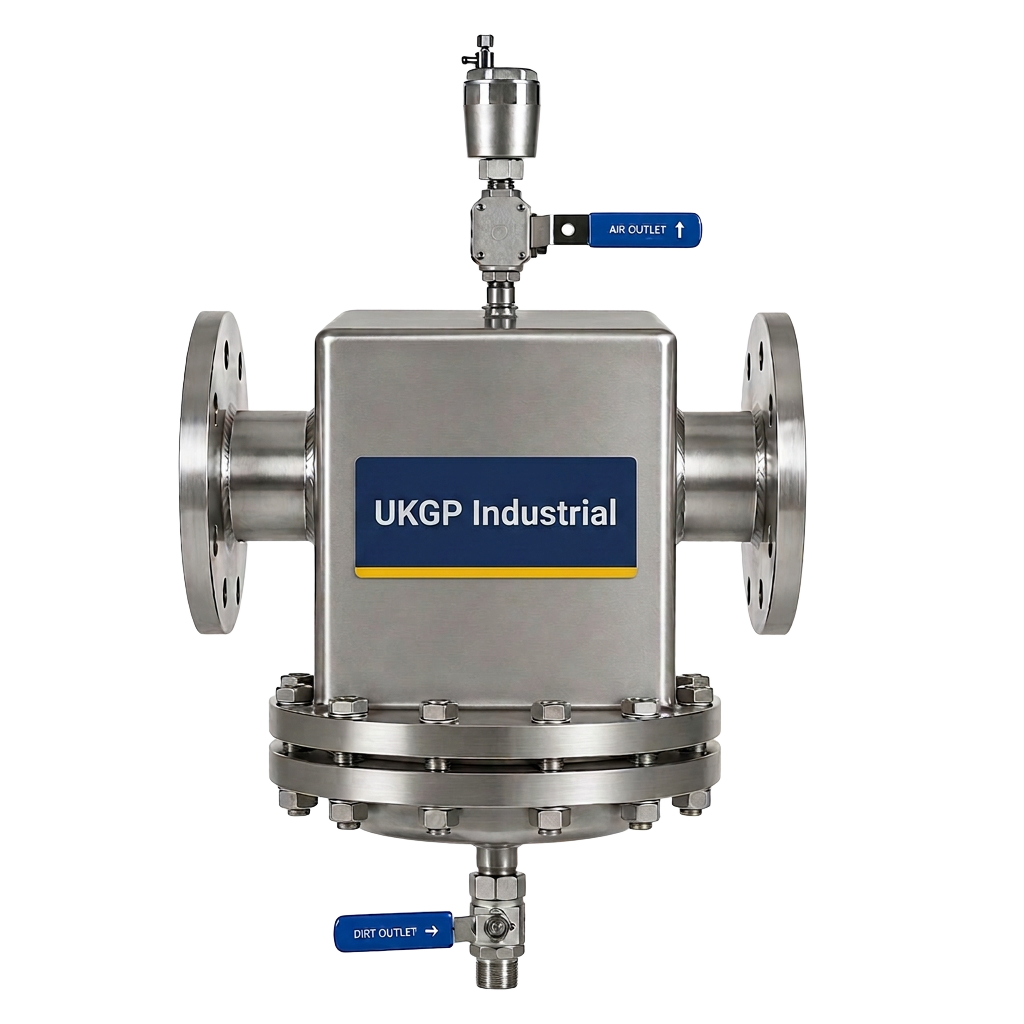
The UKGP Air and Dirt Separator represents the pinnacle of industrial filtration technology, combining high-efficiency coalescing media with a powerful magnetic catch to address both air and particulate contamination in one unit. This combined approach is essential for modern plant rooms where space is at a premium but performance cannot be compromised. The unit is designed to handle a wide range of flow rates, with sizes ranging from DN25 for smaller commercial applications up to DN300 for heavy industrial shells. By integrating this air separator for boiler systems, contractors can drastically simplify the installation process while providing dual-action protection against magnetite and microbubbles.
Each UKGP unit is constructed to professional standards, featuring PN10/16 flanged connections to ensure a high-pressure seal that meets the rigours of commercial heating and chilled water applications. The inclusion of an isolation kit as standard allows for straightforward maintenance and cleaning of the magnetic rod without the need to drain the entire system. This is a critical feature for Facilities Managers who must maintain system uptime while adhering to strict maintenance schedules. Furthermore, the 2-year warranty provides peace of mind that the component is built to withstand the demanding environment of a high-duty cycle UK plant room, supporting the long-term asset management goals of the client.
Choosing a UKGP air separator for boiler protection means investing in hardware developed specifically for the UK market. The internal coalescing media is engineered to create a low-velocity zone where microbubbles can rise and be expelled through the automatic air vent, while suspended solids are slowed and captured by the magnetic core. This process ensures that the water quality remains high, which is a key requirement for satisfying the warranty conditions of leading commercial boiler manufacturers. By specifying our DN25-DN300 range, you ensure that your project benefits from a robust, high-specification solution that is both easy to install and exceptionally reliable over its operational lifespan.
- Combined coalescing media and magnetic catch for dual filtration
- Comprehensive size range from DN25 to DN300 with flanged PN10/16 fittings
- Supplied with an isolation kit for easier, no-drain maintenance
- Backed by a 2-year warranty for commercial and industrial peace of mind
The Impact of Air Removal on Heat Exchanger Longevity
Heat exchangers are the most vulnerable components in any heating system when water quality is compromised. Whether you are using a plate heat exchanger for domestic hot water (DHW) generation or the internal heat exchanger of a high-efficiency condensing boiler, the presence of air can lead to devastating results. Air bubbles resting against the metal surfaces of the heat exchanger act as insulators, causing localized 'hot spots.' These hot spots lead to thermal stress and eventually the cracking of the exchanger walls. An air separator for boiler protection ensures that the heat transfer surface is always in full contact with the fluid, maximizing heat exchange and preventing mechanical failure.
Furthermore, an air-rich environment facilitates the oxidation of ferrous metals, leading to the production of magnetite (sludge). This sludge often settles in the tight plate gaps of a plate heat exchanger, significantly increasing the pressure drop and reducing the system’s ability to meet heat demand. By using an air separator for boiler circuits, you stop this process at the source. Modern systems using high-performance stainless steel or aluminium-silicon heat exchangers are particularly sensitive to these issues. Effective deaeration and dirt separation are often cited as mandatory by major UK commercial boiler OEMs to ensure that the performance of their units does not degrade over the first few years of service.
Specifying an air separator for boiler systems also assists in maintaining the correct flow velocity across the heat exchanger. When air pockets form, they create resistance, forcing the pump to work harder and often pushing it out of its most efficient operating curve. By removing air, the hydraulic resistance remains predictable and within design parameters. This is especially important in retro-fit projects where older pipework may already have high resistance. Our UKGP technical team frequently advises on the integration of these separators alongside our plate heat exchangers to create a completely optimized thermal transfer solution that stands up to the demands of modern commercial use.
- Prevention of localized overheating and thermal stress on heat exchangers
- Reduction in magnetite production which can clog plate heat exchanger gaps
- Maintenance of optimal hydraulic flow and pump efficiency
- Protection of high-efficiency stainless steel and aluminium boiler components
Installation Best Practices for M&E Contractors
Proper installation of an air separator for boiler units requires attention to both hydraulic and spatial considerations. Contractors must ensure that the unit is installed in a vertical orientation (for vertical models) or horizontal (for horizontal models) as specified by the manufacturer to allow the automatic air vent to function correctly. It is also vital to provide sufficient clearance for the removal of the magnetic rod and the flushing of the collected debris. In modern, compact plant rooms, this can be a challenge, which is why UKGP offers flanged units that allow for robust, reliable connections even in tight spaces. Ensuring the separator is and remains accessible is a core part of a BSRIA-compliant design.
During the commissioning phase, the air separator for boiler systems plays a vital role. While initial venting is done via high-point vents, the separator performs the task of continuous deaeration of the microbubbles that appear only when the system is under full fire and temperature. It is recommended to flush the dirt portion of the separator shortly after the initial commissioning to remove any construction debris or flux that has been captured. This initial 'clean' sets the system up for a successful first year of operation. M&E contractors should always document these maintenance steps in the Operation and Maintenance (O&M) manuals to ensure the Facilities Management team understands the requirements for ongoing care.
Finally, always ensure that the isolation kit is utilized during the installation. This not only facilitates easier maintenance but also allows for the safe isolation of the magnetic core during the cleaning process without shutting down the entire heating loop. When specifying an air separator for boiler circuits for a high-occupancy building, such as a hospital or a commercial office block, the ability to perform maintenance without service interruption is a significant selling point. At UKGP, we provide the technical documentation and support required to ensure that our separators are integrated into your project seamlessly, meeting all relevant BS and CIBSE standards for industrial water management.
- Ensure correct orientation for optimal automatic air vent performance
- Provide adequate clearance for magnetic rod removal and flushing
- Perform initial debris flush during the commissioning phase
- Integrate isolation kits to enable maintenance without system shutdown
Commercial Benefits and Long-Term ROI
The commercial argument for installing an air separator for boiler plants is clear and compelling. The return on investment (ROI) is realized through reduced fuel consumption, fewer emergency call-outs, and the extended lifespan of expensive plant assets. An air-saturated system can be up to 10% less efficient than a properly deaerated one, leading to massive differences in annual energy bills for large-scale facilities. By effectively removing air, the system maintains its peak thermodynamic performance, ensuring that the energy generated by the boilers is efficiently transferred to the building’s heated spaces without waste.
Maintenance costs are also significantly lowered. Air is the catalyst for the corrosion that leads to valve sticking, pump seal failure, and the blocking of sensitive control equipment. When an air separator for boiler systems is in place, the frequency of these failures drops. This allows FM teams to move from a reactive 'fix-on-fail' model to a much more cost-effective planned preventative maintenance (PPM) schedule. This reliability is particularly valuable in critical infrastructure where heating or hot water failure can have serious operational consequences. The cost of a UKGP separator is often recovered within the first two years through these savings alone.
In a market increasingly focused on Net Zero and sustainability, specifying components that enhance system efficiency is a key responsibility for building services consultants. A well-specified air separator for boiler duty is a simple yet effective way to verify that a building is operating as sustainably as possible. It reduces the carbon footprint by ensuring that every kilowatt of thermal energy is delivered as intended. For procurement leads, choosing a UK-based supplier like UKGP ensures that you receive verified technical data and localized support, making the procurement process as efficient as the equipment itself. Reach out to our Surrey office to discuss your DN25-DN300 requirements today.
- Direct reduction in annual fuel consumption through better heat transfer
- Fewer emergency repairs and call-outs for air-related system failures
- Extension of the operational lifespan for boilers, pumps, and valves
- Documented contribution to building sustainability and carbon reduction
Frequently asked questions
Why is an air separator for boiler systems necessary if I have high-point vents?
- High-point vents only remove large pockets of trapped air at the start of a system or during filling. An air separator for boiler systems is designed to remove microbubbles and dissolved air that are released continuously as water is heated. These microbubbles are too small to be captured by standard air vents and must be coalesced and removed to prevent corrosion and efficiency loss.
What size air separator do I need for a commercial plant room?
- The size of the air separator for boiler applications is determined by the flow rate (m/s) and pipe diameter. UKGP provides units from DN25 up to DN300. It is essential to select a size that maintains a low velocity through the coalescing media—typically around 1.0 to 1.5 m/s—to allow bubbles to rise and dirt to settle effectively. Contact UKGP for a sizing calculation based on your system's flow requirements.
Does the UKGP air and dirt separator require frequent maintenance?
- The UKGP air separator for boiler systems is designed for low maintenance. While the air venting is automatic, the magnetic dirt trap should be cleaned periodically. Thanks to our included isolation kit, the magnetic rod can be removed and the debris flushed out quickly without draining the system. We recommend checking the trap after the first month of operation and then during annual service visits.
How does an air separator help with BSRIA BG50 compliance?
- BSRIA BG50 provides guidelines for managing water quality in closed-loop systems. A primary requirement is the removal of dissolved oxygen to prevent corrosion. An air separator for boiler circuits is a fundamental tool for achieving this, as it continuously removes the air that enters the system. Using our separators helps engineers maintain the water chemistry required by BG50, protecting the system from magnetite and pitting.
What is the warranty on UKGP air and dirt separators?
- Our industrial air and dirt separators come with a 2-year warranty as standard. This covers the integrity of the flanged PN10/16 body and the internal coalescing media, providing long-term assurance for M&E contractors and end-users in demanding UK commercial and industrial environments.