The Fundamental Principles of Plate Heat Transfer
At its core, a plate heat exchanger consists of a series of thin, corrugated metal plates designed to transfer heat between two fluids. Unlike traditional shell and tube exchangers, which rely on a large volume of fluid, PHEs utilise a high surface-area-to-volume ratio. The primary and secondary fluids flow through alternating channels formed by the plates, usually in a counter-current arrangement to maximise the temperature gradient and, consequently, the heat transfer rate (Q).
The plates are typically pressed with a chevron or herringbone pattern. This geometry is not merely structural; it is engineered to induce turbulence even at low flow velocities. High turbulence ensures a high Reynolds number, which significantly reduces the 'fouling factor' and increases the overall heat transfer coefficient (U). In UK plant room applications, this efficiency allows for a 'temperature approach' as narrow as 1°C, a feat rarely achievable with alternative heat exchange technologies.
The material of construction is critical. For standard LTHW (Low Temperature Hot Water) and chilled water systems, Grade 304 or 316 stainless steel is the industry standard. However, in applications involving saline environments, swimming pool water, or aggressive process chemicals, Titanium or SMO 254 plates are specified to prevent pitting and stress corrosion cracking. Understanding the fluid chemistry—particularly chloride levels—is essential for long-term asset integrity.
Gasketed Plate Heat Exchangers (GPHE)
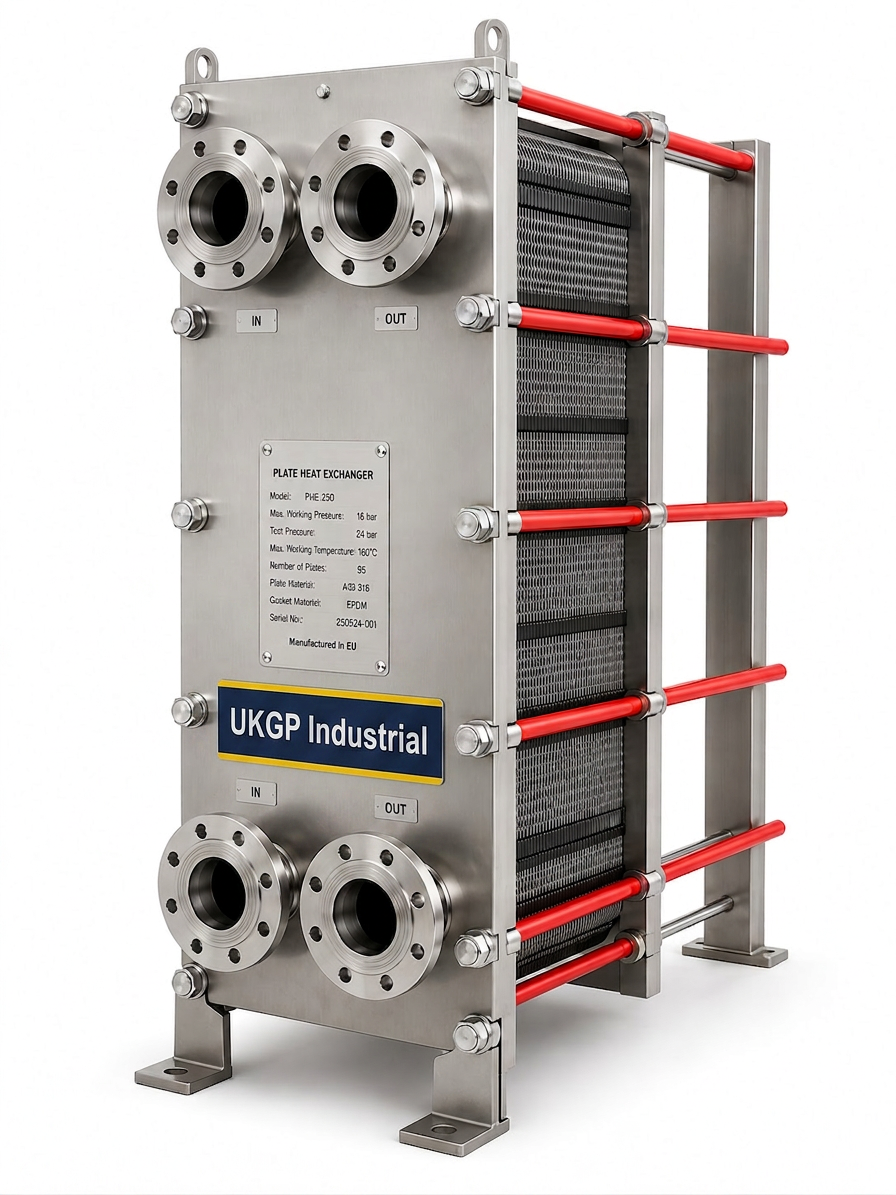
Gasketed Plate Heat Exchangers, often referred to as 'plate and frame' exchangers, are the most versatile variant. They consist of a plate pack compressed between a fixed head and a moveable follower (pressure plate) using high-tensile tie bolts. The primary advantage of the GPHE is its serviceability; the unit can be completely dismantled for manual cleaning, plate inspection, or the addition of extra plates should the system load increase in the future.
The gaskets—typically EPDM for heating applications or Nitrile (NBR) for oil and chilled water—are designed to prevent fluid cross-contamination. Most modern GPHEs utilise 'glue-less' clip-on or snap-on gaskets, which simplify the re-gasketing process during refurbishment. In UK district heating substations, GPHEs are preferred because they can be sized for very high duties (multi-MW) while remaining maintainable within the constraints of a basement plant room.
From an engineering perspective, the frame must be rated to the system design pressure, typically 6, 10, or 16 bar in standard commercial builds, though 25 bar variants are common for high-rise developments. Selection must comply with the Pressure Equipment Directive (PED) and be sized using software that accounts for the specific viscosity and thermal properties of the heat transfer media, including glycol concentrations where applicable.
Brazed Plate Heat Exchangers (BPHE)
For smaller capacities and high-pressure applications where maintenance access is not a primary concern, Brazed Plate Heat Exchangers are the preferred choice. These units eliminate the frame and gaskets entirely, instead vacuum-brazing the stainless steel plates together using a copper or nickel filler. This results in a hermetically sealed, incredibly compact unit capable of withstanding pressures upwards of 40 bar and temperatures exceeding 200°C.
BPHEs are ubiquitous in domestic and light commercial boiler sets, as well as heat pump monoblocs. Their compact nature makes them ideal for skids and package substations. However, the engineer must be aware that because they cannot be opened, they are susceptible to permanent fouling if the system water quality is not strictly controlled according to BSRIA BG29/21. If a BPHE becomes scaled or clogged with magnetite, chemical cleaning (CIP - Clean In Place) is the only remedy, and in severe cases, the unit must be replaced.
Recent innovations in BPHE technology include 'double-wall' designs for DHW applications. These provide a safety barrier between the heating medium and the potable water, ensuring that a single plate failure does not lead to cross-contamination, fulfilling local water authority requirements for fluid category 4 protection in certain jurisdictions.
Frequently asked questions
What is the significance of LMTD in plate heat exchanger selection?
- LMTD (Logarithmic Mean Temperature Difference) represents the effective temperature driving force. A lower LMTD suggests a more efficient heat transfer process but may require a larger surface area (more plates). In UK district heating, low return temperatures are targeted to maximise LMTD and network efficiency.
Does the plate corrugation pattern affect pressure drop?
- The chevron pattern (herringbone) creates turbulence at low Reynolds numbers, which breaks down the stagnant boundary layer and significantly increases the heat transfer coefficient compared to shell and tube designs. No, a higher angle (hard plates) increases pressure drop, while a lower angle (soft plates) reduces it.
How often should a gasketed PHE be serviced?
- Gasketed PHEs should be serviced according to BSRIA BG50 guidelines. Common indicators for service include a rise in secondary approach temperature, an increase in differential pressure across the primary/secondary ports, or visible external weeping from the gasket stack.
Can plate heat exchangers be used with low-temperature heat pumps?
- Yes, but specific considerations are required. High-performance heat pumps often operate with narrow temperature differentials (e.g., 5-7°C). PHEs must be oversized with low-pressure-drop plates to ensure the heat pump compressor operates within its design envelope.