The Dual Threat: Why Separation is Mandatory
The efficiency of any hydronic system is fundamentally tied to the quality of its heat transfer fluid. Air, in its several forms—trapped pockets, microbubbles, and dissolved gases—acts as an insulator, reducing the effective heat transfer coefficient of heat exchangers and radiators. Furthermore, oxygen is a primary precursor for aerobic corrosion, leading to the formation of magnetite. If left unaddressed, air causes noisy operation, pump cavitation, and premature air-lock failures in terminal units.
Simultaneously, 'dirt'—a broad term encompassing everything from construction debris to the fine magnetite sludge generated over years of operation—presents a physical threat. Modern boilers, particularly those with aluminium or stainless steel heat exchangers, feature narrow waterways that are easily fouled. Suspended solids also act as an abrasive, eroding pump impellers and control valve seats, leading to system imbalance and loss of control authority.
BSRIA BG29/21 (Pre-commissioning Cleaning of Pipework Systems) and BG50 (Water Treatment for Closed Heating and Cooling Systems) explicitly highlight the need for effective filtration and deaeration. A combined air and dirt separator provides a single-point solution to address both issues, mitigating the need for excessive chemical dosing by removing the mechanical stressors that cause chemical breakdown and biological growth.
- Dissolved air in the fill water.
- Microbubbles released as water is heated.
- Installation debris, welding slag, and flux residues.
- Magnetite (black iron oxide) resulting from ongoing corrosion.
The Physics of Air Separation: Microbubble Deaeration
To understand how an air separator works, one must differentiate between 'free air' (which can be removed by simple VAATs) and 'microbubbles'. Microbubbles are microscopic gas pockets that cling to pipe walls and heat exchange surfaces due to surface tension. They cannot be removed by standard air vents because they remain entrained in the fast-moving flow of the water.
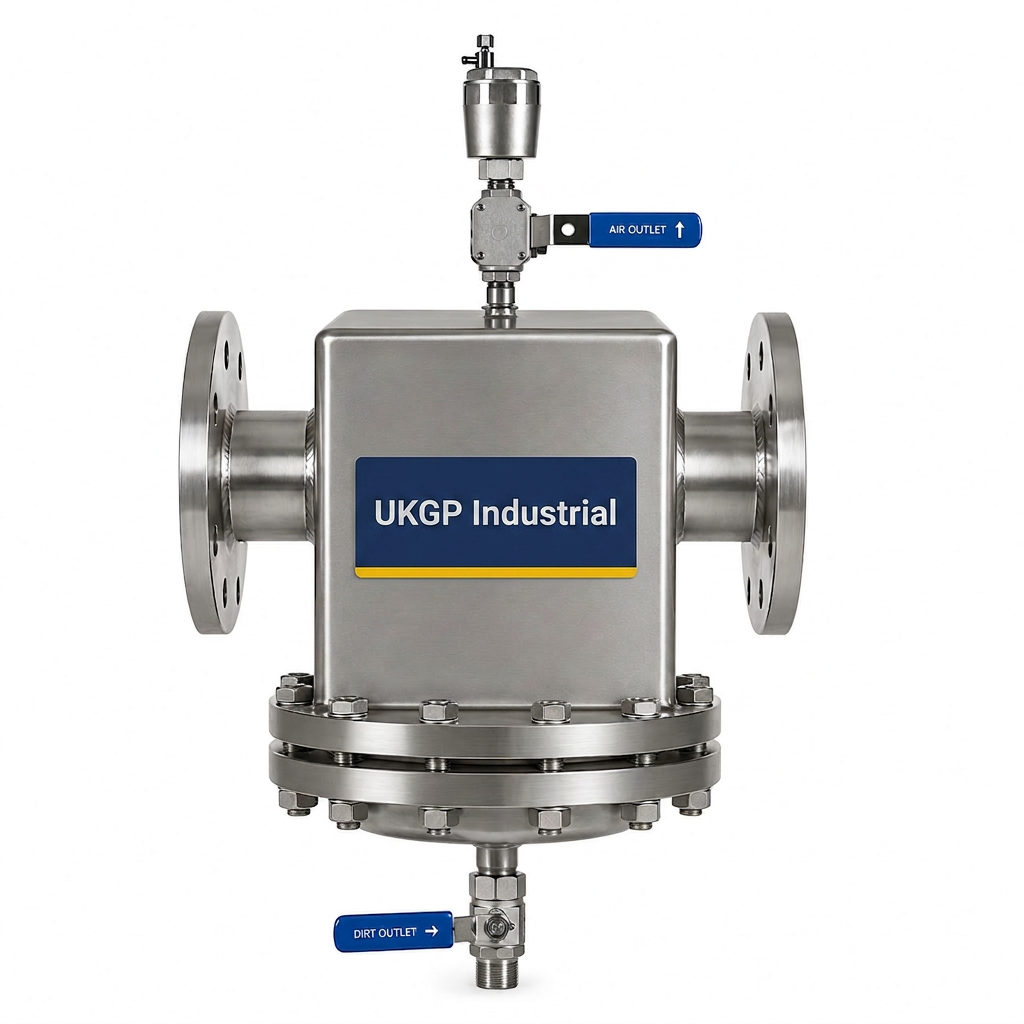
The internal mechanism of a high-performance air separator typically uses a coalescence medium—often a stainless steel wire mesh, a Pall ring bed, or a series of baffles. As the fluid enters the body of the separator, its velocity is significantly reduced. This reduction in velocity, combined with the turbulence created by the internal medium, causes microbubbles to collide and fuse into larger bubbles (coalescence). These larger bubbles then gain enough buoyancy to rise out of the flow and into the air chamber at the top of the unit.
Temperature placement is also vital. Following Henry's Law, air is least soluble at the highest temperature and lowest pressure. Consequently, air separators are most effective when installed on the flow pipe immediately after the heat source in LTHW systems, or on the return pipe before the chiller in chilled water systems, where the fluid is at its warmest.
- Henry’s Law: The solubility of a gas in a liquid is proportional to its partial pressure.
- Thermal Solubility: Gas solubility decreases as temperature increases.
- Velocity Reduction: Slowing the fluid flow allows gas bubbles to rise.
Frequently asked questions
Is a separator a substitute for BSRIA BG29/21 flushing?
- While they provide continuous protection, they are not a substitute for the initial pre-commissioning cleaning and flushing required under BSRIA BG29/21. They are, however, critical for maintaining the system's clean state as per BG50.
Where should a combined air and dirt separator be installed?
- For microbubble deaeration, the device should be installed at the hottest point of the system (the flow from the boiler or heat source) where gas solubility is lowest. For dirt separation, it should ideally be on the return to protect the heat exchanger. Combined units are typically installed on the flow to prioritise deaeration.
What are the pressure and temperature limits for standard industrial units?
- Standard units are often rated for 10 bar and 110°C. For modern district heating or high-rise applications, high-pressure variants (16-25 bar) and high-temperature models (180°C+) must be specified.
How often should a dirt separator be blown down?
- It depends on the system's condition. In new, well-flushed systems, quarterly inspection is usually sufficient. In legacy systems or those with known corrosion issues, monthly purging of the sludge valve may be necessary.
Can I use a low-loss header instead of a separator?
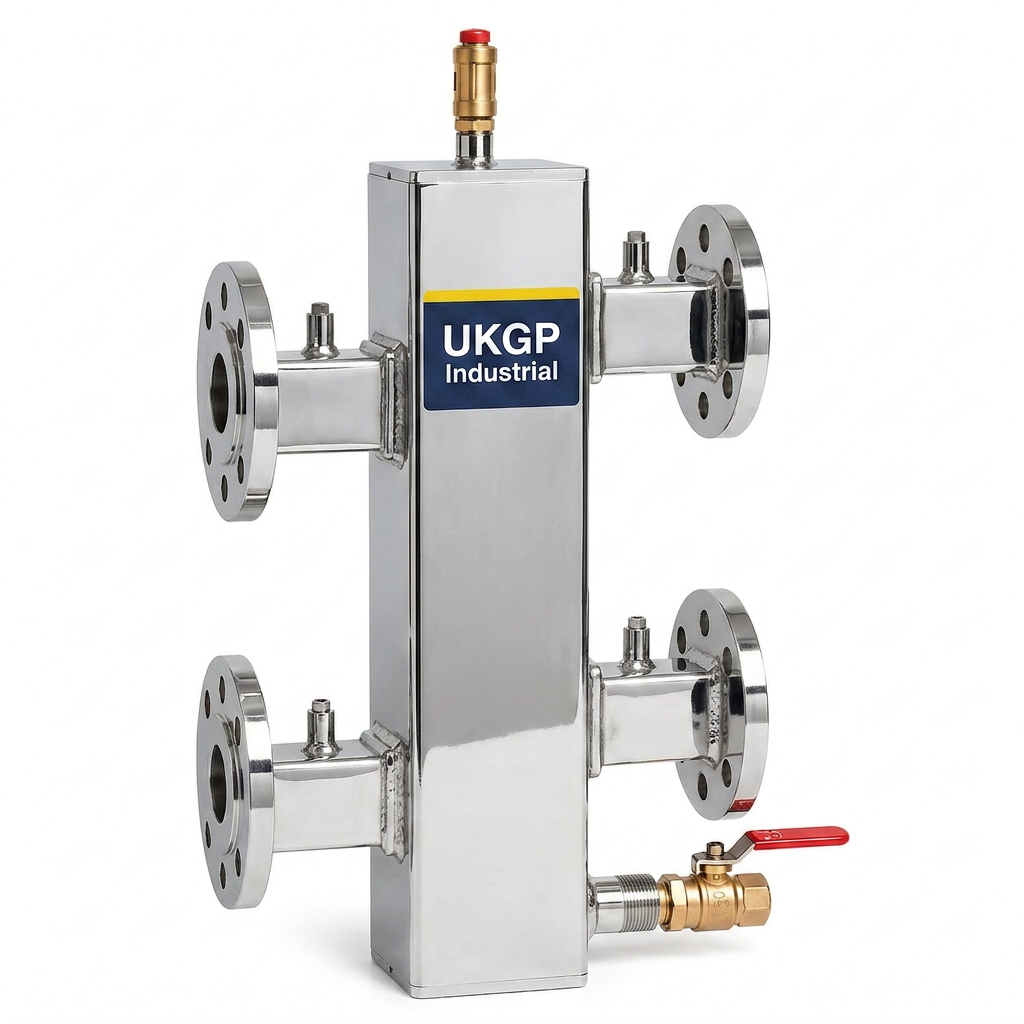
- No. A separator is a passive device with low pressure drop. A low-loss header is a hydraulic break used to decouple primary and secondary circuits. While some headers include internal baffles for separation, dedicated separators offer significantly higher efficiency.