The Critical Role of Gas and Solid Removal
Oxygen, nitrogen, and suspended solids are the primary drivers of degradation in closed-loop LTHW and CHW systems. Oxygen facilitates the oxidation of ferrous components, leading to the formation of magnetite (black iron oxide sludge). Nitrogen, while inert, creates air pockets that cause noise, restrict flow, and act as an insulator on heat transfer surfaces. In the context of the UK’s transition to lower system temperatures, the buoyancy of microbubbles is reduced, making passive removal more challenging.
BSRIA BG29/21 (Pre-commissioning Cleaning of Pipework Systems) and BG50/2021 (Water Treatment for Closed Heating and Cooling Systems) emphasise that mechanical filtration and deaeration are fundamental to the life-cycle strategy of a building. Failing to remove these contaminants results in premature pump seal failure, blocked control valves, and a significant drop in seasonal COP for heat pump installations.
- Protects highly sensitive heat exchangers in heat pump and condensing boiler circuits.
- Maintains system ΔT by preventing laminar insulation caused by air pockets.
- Reduces the risk of microbial influenced corrosion (MIC) by eliminating oxygen.
- Ensures compliance with BSRIA BG29/21 cleanliness standards during and after commissioning.
Technical Characterisation: Passive Separators
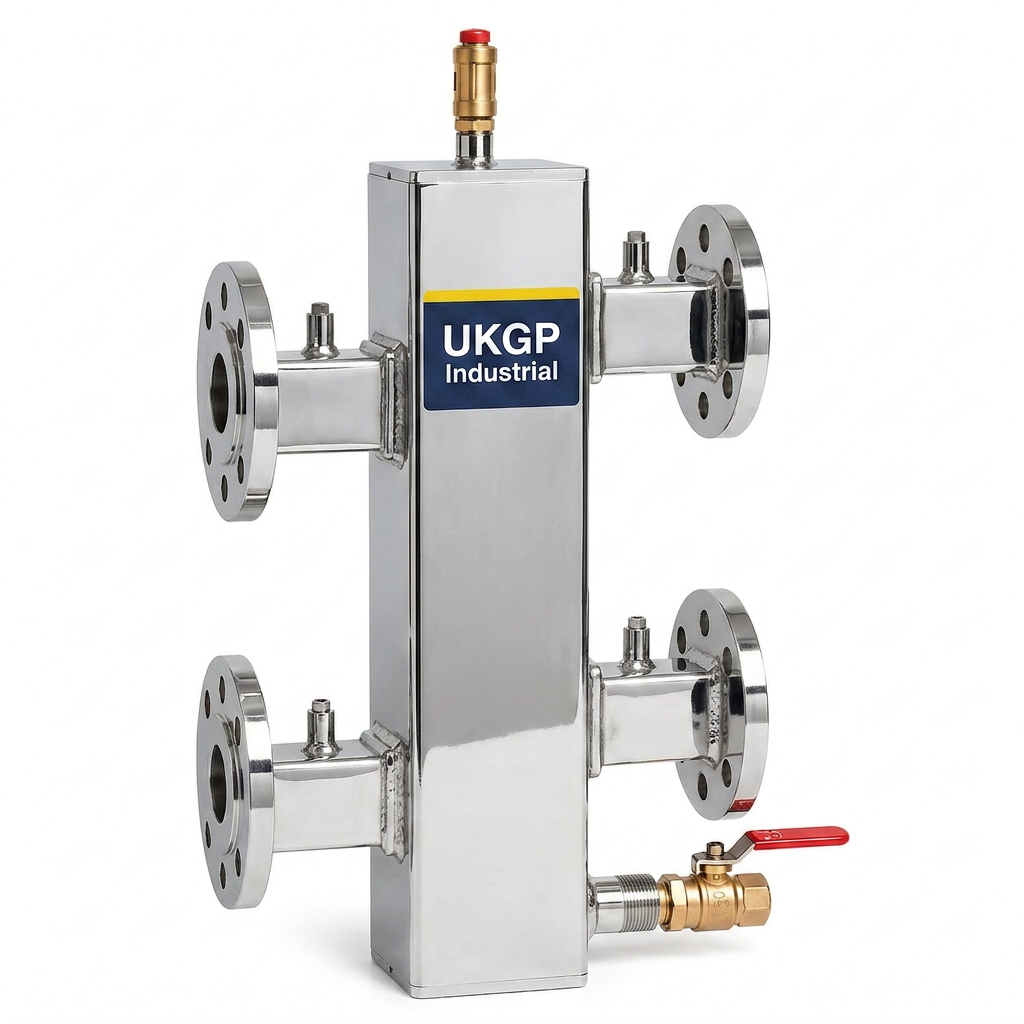
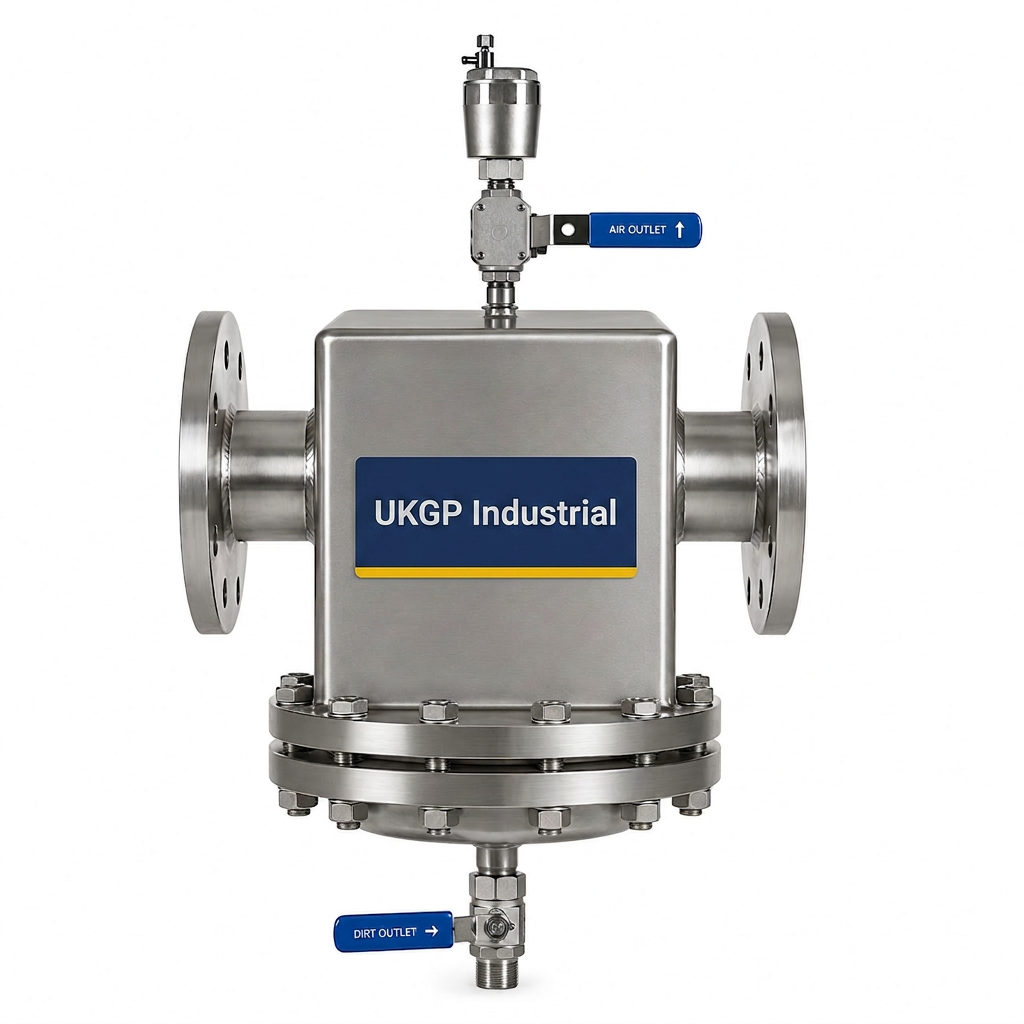
Combined air and dirt separators are passive devices typically installed on the main flow or return pipework. These units utilise internal components—such as PALL rings, stainless steel mesh, or centrifugal baffles—to create a 'quiet zone'. In this region, fluid velocity is reduced, allowing microbubbles to coalesce and rise to an automatic air vent at the top, while heavier dirt particles settle into a collection chamber at the base.
Modern UKGP Industrial air and dirt separators are frequently specified with magnetic inserts. Since magnetite is the most prevalent contaminant in UK systems, adding dry-pocket neodymium magnets significantly increases the capture rate of sub-micron ferrous particles that would otherwise pass through a standard mesh. These units are 'fit and forget' in terms of power requirements but require regular blow-down maintenance to evacuate the captured sludge.
The efficacy of these units is highly dependent on Henry’s Law: the solubility of gas in a liquid is proportional to the partial pressure of that gas. Because separators are usually installed at the point of lowest pressure (the pump suction) or highest temperature (the boiler flow), they are effective at removing gases that have already come out of solution. However, they cannot remove dissolved gases held within the fluid.
Active Vacuum Deaeration: When is it Necessary?
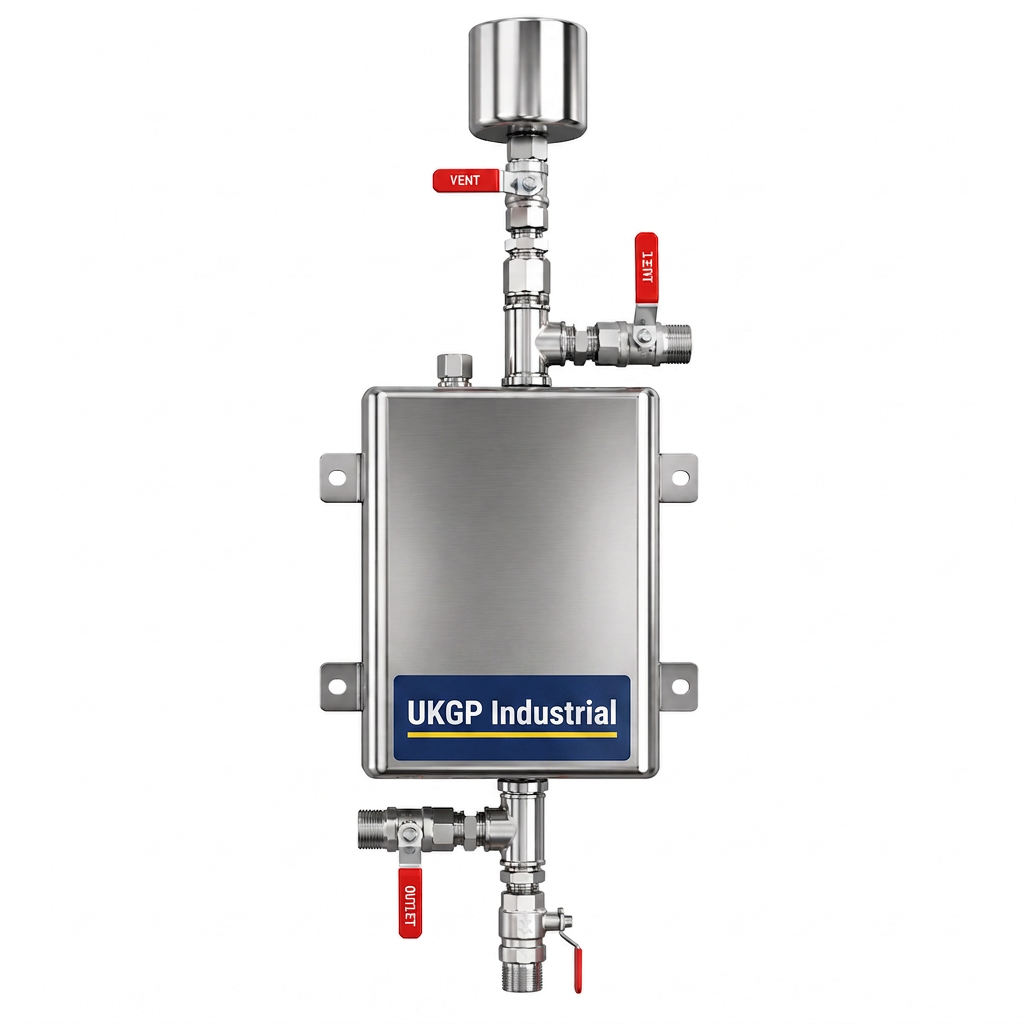
A vacuum deaerator (or atmospheric degasser) is an active, packaged plant item that bypasses a portion of the system flow into a pressure-controlled vessel. By creating a vacuum within the vessel, the boiling point of the water is lowered, forcing all dissolved gases—including those tucked away in the furthest reaches of the system—to be released and vented. This process is far more aggressive and comprehensive than passive separation.
The primary driver for selecting a vacuum deaerator over a standard air separator is system height and complexity. In high-rise commercial developments in London or Manchester, the static head of the system keeps gases in solution even at high flow temperatures. A separator in the basement plant room will be unable to 'see' the air that is dissolved under 6 bar of pressure. Vacuum deaerators are also essential in systems with low temperature differentials where the temperature rise isn't sufficient to drive gas out of solution naturally.
While more expensive and requiring an electrical supply, a vacuum deaerator ensures the system water remains 'unsaturated.' This aggressive state means the water actively seeks out and absorbs stray air pockets in the terminal units, effectively purging the system over time. For critical infrastructure or systems where air locks in remote ceiling voids would be catastrophic, the deaerator is the only viable engineering choice.
Dirt Separation and BG29/21 Compliance
While air removal is about efficiency, dirt removal is about protection. BSRIA BG29/21 outlines strict suspended solid limits during the pre-commissioning stage. A combined air and dirt separator serves as the primary line of defence during the initial weeks of operation. If the system is large, however, a separator alone may struggle with the volume of debris generated during the 'bedding-in' period of a new build.
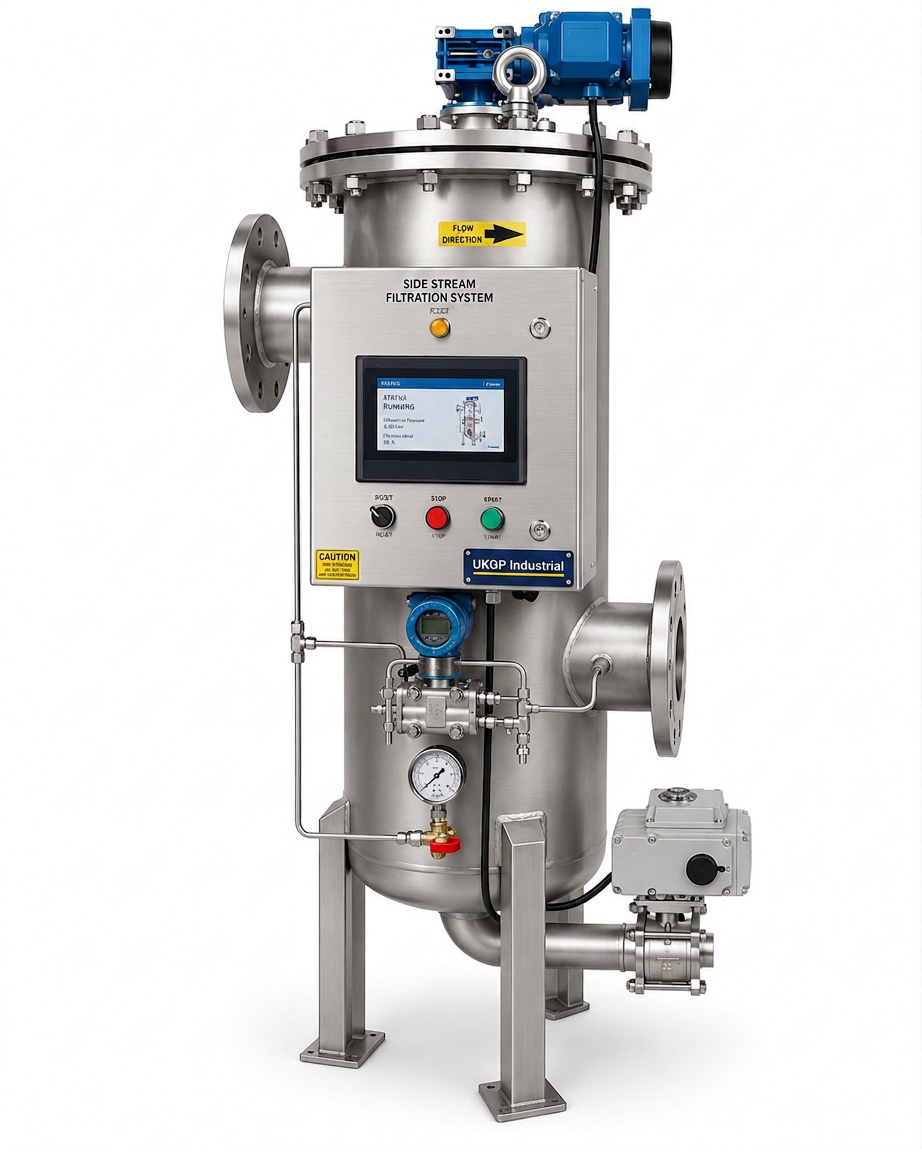
In these scenarios, specifying a side-stream filtration unit alongside a primary dirt separator is best practice. The separator handles the high-velocity main flow, capturing larger particles and magnetite, while the side-stream filter (often a 5-micron bag or cartridge filter) continuously polishes a percentage of the flow. This dual-approach is particularly relevant when retrofitting new high-efficiency boilers into an existing, potentially contaminated, Victorian-era pipework system.
Location and Installation Constraints
For an air and dirt separator to function, it must be sized for the full system flow rate. If the velocity exceeds 1.5 m/s, the 'quiet zone' becomes turbulent, and separation efficiency drops to near zero. Consequently, these units can become physically large and heavy in high-flow applications (>DN200), requiring significant plant room footprint and structural support.
In contrast, a vacuum deaerator is installed on a bypass (side-stream). The pipework connections are typically small (usually 15mm or 22mm), meaning the unit can be tucked away in a corner of the plant room regardless of the main header size. This makes deaerators an attractive solution for plant room upgrades where space on the main flow/return headers is non-existent. For engineers, the choice often boils down to a trade-off between the simplicity of a separator and the precision/space-efficiency of a deaerator.
Final Engineering Comparison
The decision between an air and dirt separator and a vacuum deaerator should be based on the system's static pressure and the 'criticality' of the heat emitters. For a standard 2-3 storey school or office block, a high-quality UKGP Industrial air and dirt separator with a magnetic insert is usually sufficient to maintain the water quality required by BG29/21 and BG50.
However, for district heating schemes, high-rise residential towers, or data centre cooling loops, the risk of trapped air and the resulting corrosion is too high to rely on passive separation. In these instances, the vacuum deaerator is the standard. In the most robust designs, engineers specify a combined dirt separator on the return to protect the plant, and a vacuum deaerator on a bypass to manage the dissolved gas content of the entire loop.
- Static height: Use deaerators for buildings over 15-20 metres.
- Budget: Separators are more cost-effective for smaller, low-rise commercial kits.
- Maintenance: Separators require manual blow-down; deaerators require annual mechanical servicing.
- System Water: Use vacuum deaerators for high-volume chilled water systems where gas solubility is high and temperatures are low.
Frequently asked questions
Can an in-line air and dirt separator replace a vacuum deaerator?
- In-line separators are passive and remove only free air/microbubbles. Vacuum deaerators are active and can remove dissolved gases from solution, making them superior for tall buildings or high-temperature systems where gas solubility is a concern.
What does BSRIA BG29/21 say about dirt separation?
- BSRIA BG29/21 recommends their use as part of a pre-commissioning cleaning and maintenance strategy to protect heat exchangers and control valves from magnetite and debris.
How do I size an air and dirt separator?
- A separator should be sized based on the flow rate (m³/h) at the point of installation, ensuring the velocity remains within the manufacturer's specified range (typically <1.5 m/s) for effective centrifugal or coalesced separation.
Do I need side-stream filtration if I have a dirt separator?
- While separators are highly effective at capturing particulates, side-stream filtration is often required for secondary circuits or systems with very high volumes to ensure continuous polishing of the water.