Material Properties and Grade Selection
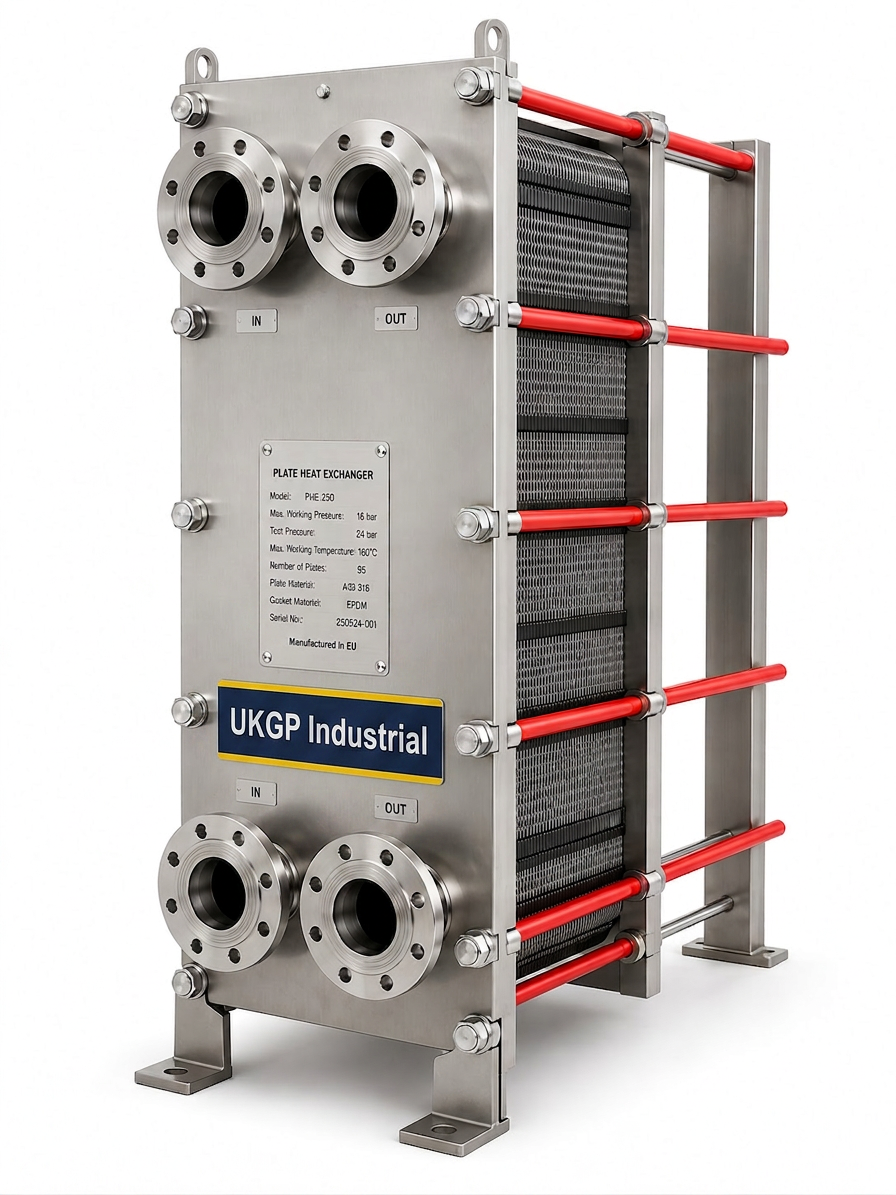
The vast majority of gasketed and brazed plate heat exchangers in the UK market utilise AISI 316L stainless steel. This grade contains approximately 2% molybdenum, which provides essential resistance to pitting and crevice corrosion in standard water-to-water applications. However, stainless steel relies on a passive chromium oxide layer for protection. In the presence of high chloride concentrations or low pH values, this layer breaks down, leading to rapid localised failure.
Titanium, specifically Grade 1 according to ASTM B265, provides an entirely different level of chemical stability. It forms a tenacious, self-healing oxide film that is remarkably stable across a wide range of temperatures and pH levels. While 316 stainless steel is vulnerable to stress corrosion cracking (SCC) at temperatures exceeding 60°C in the presence of chlorides, titanium is unaffected by chlorides at any temperature encountered in HVAC or standard industrial process cooling loops.
- AISI 304: Suitable for basic HVAC applications, though rarely specified for PHEs due to low pitting resistance.
- AISI 316/316L: The industry standard for UK DHW and LTHW systems. 316L contains lower carbon to mitigate intergranular corrosion after welding.
- Titanium (Grade 1): Offers the highest strength-to-weight ratio and is virtually immune to chloride-induced corrosion in standard plant room conditions.
Frequently asked questions
At what chloride concentration should I switch from 316 Stainless Steel to Titanium?
- AISI 316 stainless steel generally becomes susceptible to pitting and stress corrosion cracking when chloride levels exceed 200-250 ppm, especially at elevated temperatures above 60°C. Titanium remains immune even in seawater concentrations.
Does Titanium have a lower heat transfer efficiency than Stainless Steel?
- Due to the material's superior strength and corrosion resistance, titanium plates can often be manufactured thinner (typically 0.4mm to 0.5mm) than stainless steel counterparts, resulting in excellent heat transfer coefficients that partially offset the higher material cost.
Can I use Titanium in brazed heat exchangers?
- Gasketed PHEs (GPHEs) allow for the replacement of individual plates if localized corrosion occurs. Brazed units are disposable; if a single plate pits through, the entire unit must be replaced. In high-chloride environments, Titanium GPHEs are therefore the lower-risk long-term investment.
Should I specify Titanium for a standard district heating substation?
- For standard UK secondary heating loops (80/60°C) with low chloride levels, 316 Stainless Steel is the industry standard. Titanium is reserved for primary sea-water cooling, swimming pool water, or aggressive industrial process fluids.