Selection Criteria for UK Commercial Applications
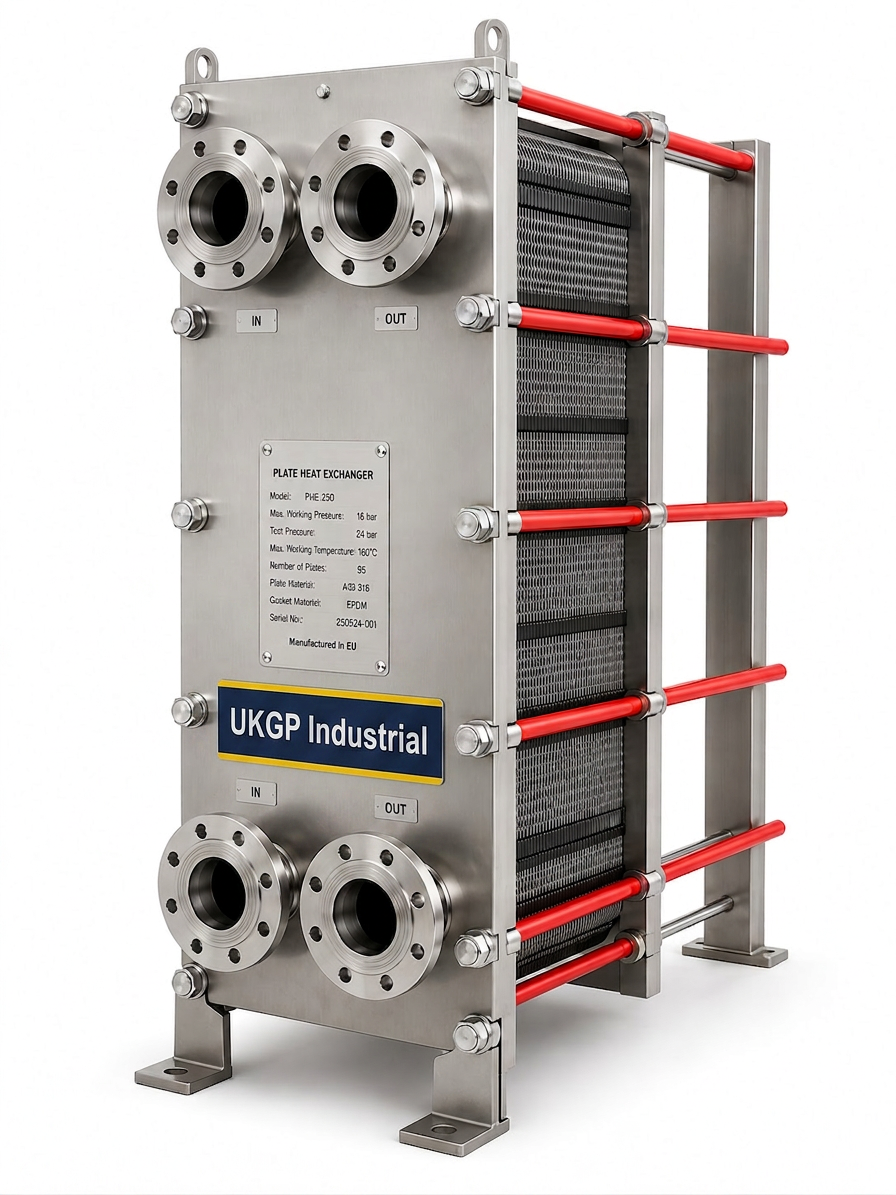
The primary selection criterion for any PHE in a UK plant room is the thermal duty, typically measured in kW. For district heating substations, engineers must calculate the peak load alongside the 'approach temperature'—the difference between the primary return and secondary flow. Modern low-temperature hot water (LTHW) systems increasingly require close approach temperatures (2-3K) to maximise the coefficient of performance (COP) of upstream heat pumps. This drives the need for high-NTU (Number of Transfer Units) plate patterns that promote turbulent flow even at lower velocities.
Material selection is equally critical. While 316L stainless steel is the industry standard for its corrosion resistance and thermal conductivity, the chloride content of the secondary water must be monitored. In applications involving potable DHW (Domestic Hot Water), the risk of stress corrosion cracking must be mitigated by ensuring water treatments are compliant with BS 8558. For high-pressure applications exceeding 25 bar, or where thermal shock is frequent, the structural integrity of the frame and the thickness of the pressure plates must be specified to BS EN 13445 standards.
- Gasketed (GPHE): Essential for large capacities and systems requiring modularity.
- Brazed (BPHE): Vacuum-brazed with copper or nickel; ideal for compact applications like HIUs and heat pumps.
- Welded/Semi-Welded: Reserved for aggressive refrigerants or high-pressure industrial processes where leaks pose a safety risk.
Frequently asked questions
What is the significance of LMTD in PHE selection?
- LMTD (Logarithmic Mean Temperature Difference) represents the effective temperature driving force between the two fluids. In high-efficiency heat networks, we aim for a low LMTD (often 5K or less) to maximise energy transfer. A smaller LMTD requires a larger surface area (more plates), increasing capital cost but significantly improving system efficiency and ensuring low return temperatures back to the primary source.
How does pressure drop affect heat exchanger performance?
- Pressure drop is proportional to the square of the flow rate. If the pressure drop exceeds the design limit (typically 30-50 kPa for commercial heating), it necessitates higher pumping power, increasing parasitic energy loads. In many cases, adding plates to the PHE can reduce velocity and pressure drop, though this must be balanced against the risk of fouling due to lower shear stress.
Which gasket material should be specified for DHW systems?
- For most UK commercial applications, EPDM (Ethylene Propylene Diene Monomer) is the standard for temperatures up to 150°C. For oil-based systems or high-temperature process fluids, Nitrile (NBR) or Viton (FKM) may be required. Always verify chemical compatibility if the system uses specific glycols or inhibited water treatments.
When should I choose a brazed PHE over a gasketed PHE?
- Brazed units are compact, cost-effective, and can handle higher pressures (up to 30-40 bar), making them ideal for heat pump monoblocs or small DHW sub-stations. However, they cannot be opened for cleaning. Gasketed units (GPHEs) are modular, allowing for plate additions and manual cleaning, making them the superior choice for large-scale district heating or systems with high fouling potential.
Does the metallurgy of the plates matter beyond standard stainless steel?
- While 304 stainless steel is common, 316L is the minimum recommended grade for UK building services to ensure resistance against pitting and crevice corrosion. In high-chloride environments, such as swimming pools or saline process cooling, Titanium plates are mandatory to prevent rapid failure.