The Fundamental Principles of Hydraulic Decoupling
Hydraulic decoupling is necessary whenever the flow rate requested by the secondary circuits (emitters, AHUs, DHW) differs from the flow rate required by the primary heat source. Without decoupling, the pumps in the primary and secondary circuits will interact, leading to unpredictable flow rates, excessive pump wear, and potential boiler 'short-cycling'. In a commercial environment, this is typically governed by CIBSE AM14 guidelines, which emphasise the importance of maintaining a neutral pressure point between circuits.
The 'neutral point' allows the primary pump to move water only through the boiler/chiller while the secondary pumps move water only through the building services. In systems using modulating boilers—such as wall-hung cascades from manufacturers like Viessmann or Vaillant—this separation is vital. It allows the boilers to maintain their minimum flow requirements regardless of whether the building's TRVs are closing or secondary pumps are ramping down.
- Primary and secondary circuits operate independently of each other's pump heads.
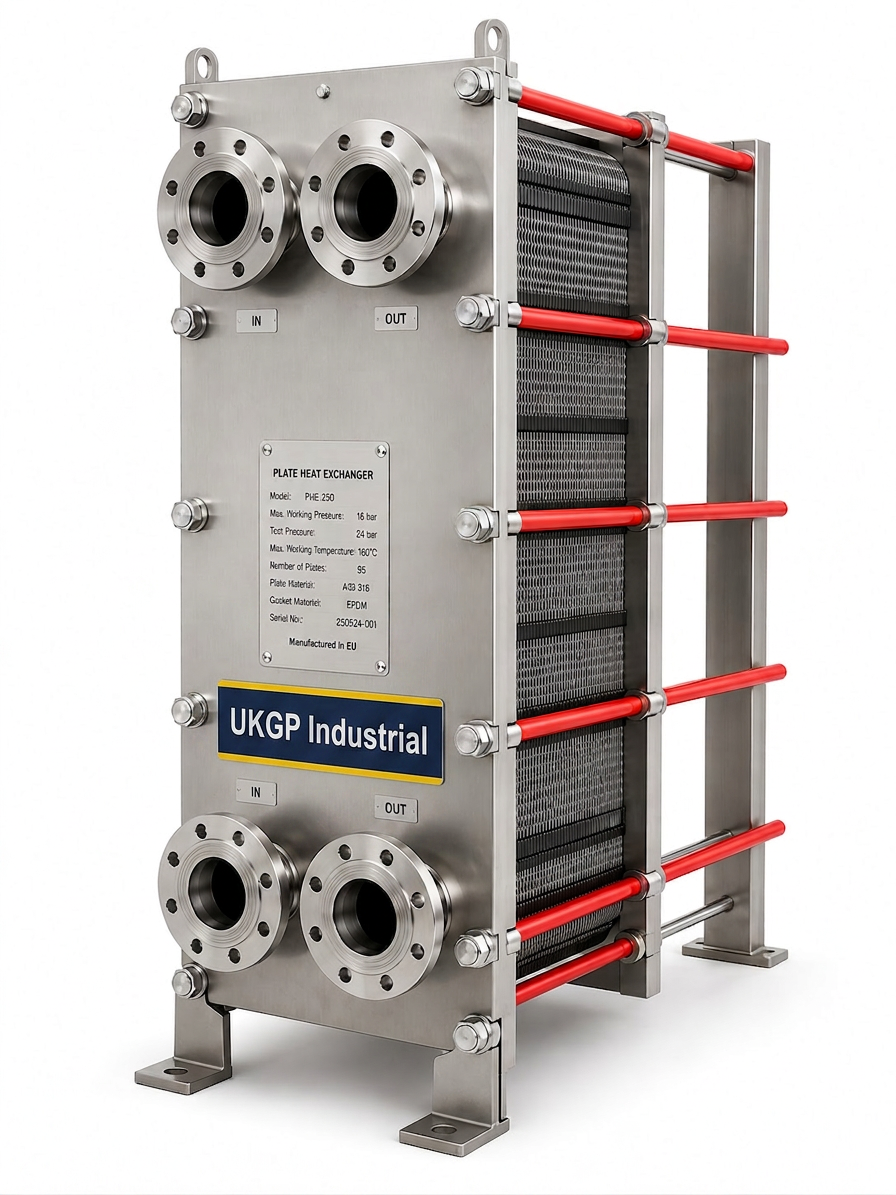
- Protection of heat exchangers from variable flow rates in the secondary circuit.
- Facilitation of accurate temperature control by preventing 'see-sawing' flow patterns.
- Improved condensation rates in condensing boilers by maintaining lower return temperatures where possible.
Low Loss Headers: The Multi-Functional Solution
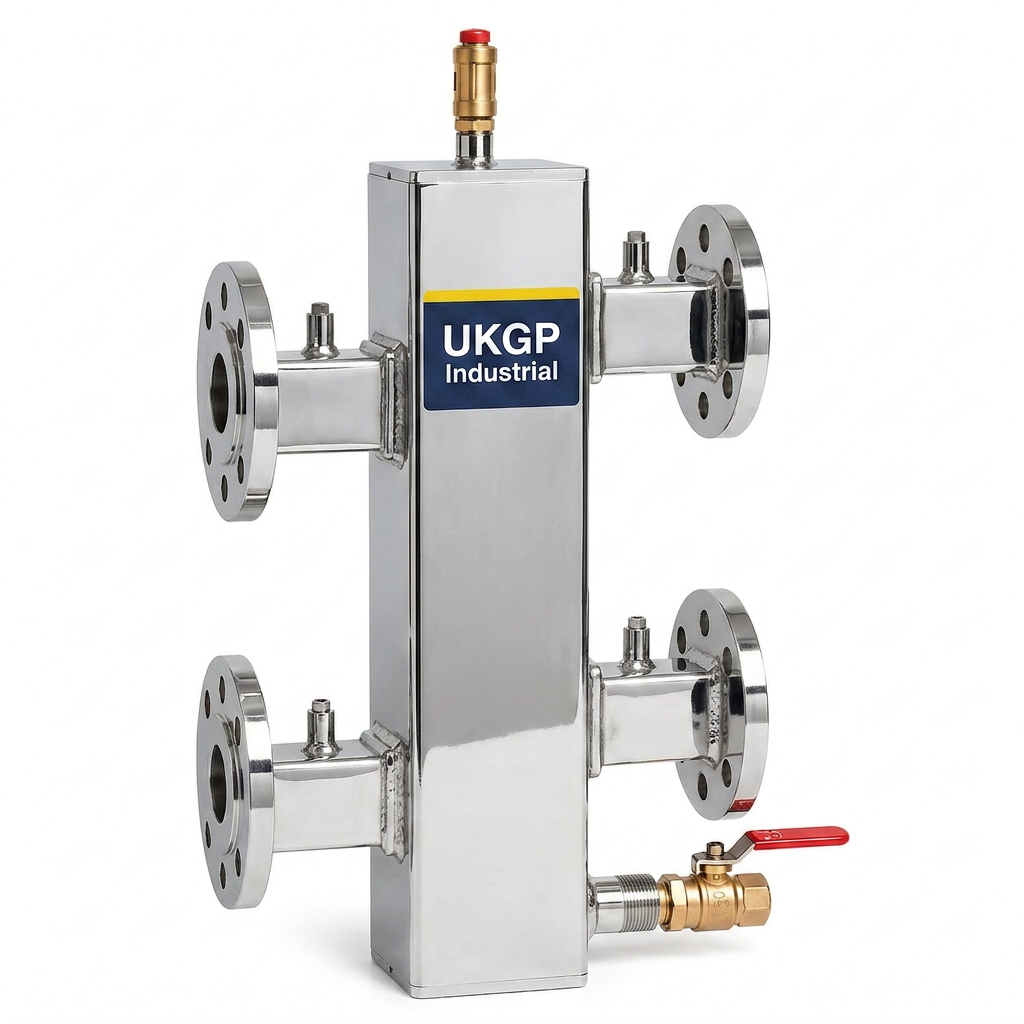
A low loss header is a vertical or horizontal vessel with a cross-sectional area significantly larger than the connecting pipework. This increased volume reduces water velocity, typically to below 0.5 m/s, creating a zone of negligible pressure drop. This allows the primary and secondary circuits to coexist without transferring kinetic energy between them. Because of its size, a well-designed LLH also serves as a secondary benefit: a central point for air and dirt separation.
UKGP Industrial low loss headers are engineered to meet these velocity requirements while often incorporating internal features for debris management. From an engineering perspective, the LLH is more 'forgiving' than close-coupled tees. It can accommodate larger fluctuations in demand and provides a more stable thermal buffer. This is particularly useful in multi-boiler cascades where the total system volume might otherwise be too low to prevent rapid cycling during low-load conditions.
Close Coupled Tees: Precision and Space Constraints
Close coupled tees, often referred to as a 'primary-secondary' pipework arrangement, achieve separation by placing the secondary circuit's supply and return connections in very close proximity on the primary loop. The theory—based on the Bernoulli principle—is that as long as the resistance between the two tees is effectively zero, the flow in the secondary circuit will only occur if the secondary pump is active. Unlike a low loss header, there is no large vessel; the 'decoupling' happens within the common pipe.
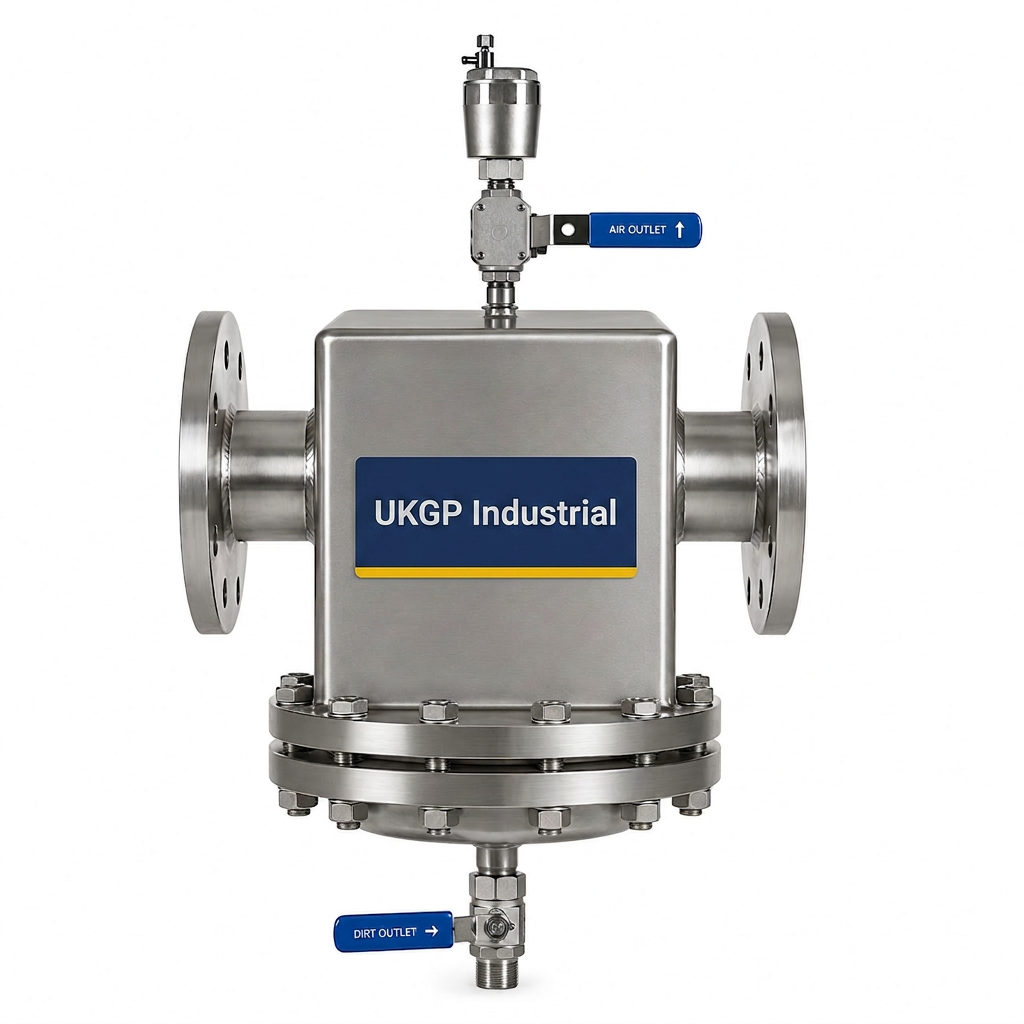
While CCTs are often favoured for their compact nature and lower initial material cost, they require precise installation. If the distance between the tees exceeds the '3D' rule (three times the pipe diameter), a pressure differential is created. This differential can ghost-drive a secondary pump even when it is switched off, leading to overheating in zones or inefficient heat distribution. Unlike LLHs, close coupled tees offer no inherent air or dirt separation, necessitating additional components like an inline air and dirt separator elsewhere in the system.
- The '3D' Rule: The distance between the centre of the flow and return tees must be no more than three times the diameter of the pipe.
- The 'Common Pipe' must be sized for the full flow of the larger circuit to ensure minimal resistance.
- Secondary pumps must have a higher head than the resistance through the tees to prevent 'dead-heading'.
Hydraulic Performance and Flow Dynamics Comparison archaeology
When evaluating hydraulic performance, the LLH is the superior choice for systems with high-head secondary pumps or where flow rates are highly variable. The internal volume of the LLH acts as a hydraulic 'moat', effectively isolating the primary circuit from the turbulence of the secondary side. This is critical for modern boilers with sensitive flow sensors. If a secondary pump ramps up rapidly, a LLH prevents that sudden suction from being felt directly at the boiler heat exchanger.
In contrast, close coupled tees rely entirely on the lack of resistance in the common pipe. In high-flow industrial applications, achieving a true 'zero' pressure drop across a 100mm or 150mm common pipe section is physically difficult. Any misalignment or internal burrs in the pipework at the tee junctions can introduce enough turbulence to disrupt the hydraulic balance. For this reason, for most UK commercial projects exceeding 100kW, the LLH is the industry standard for reliability.
Operational Costs and Long-term Maintenance
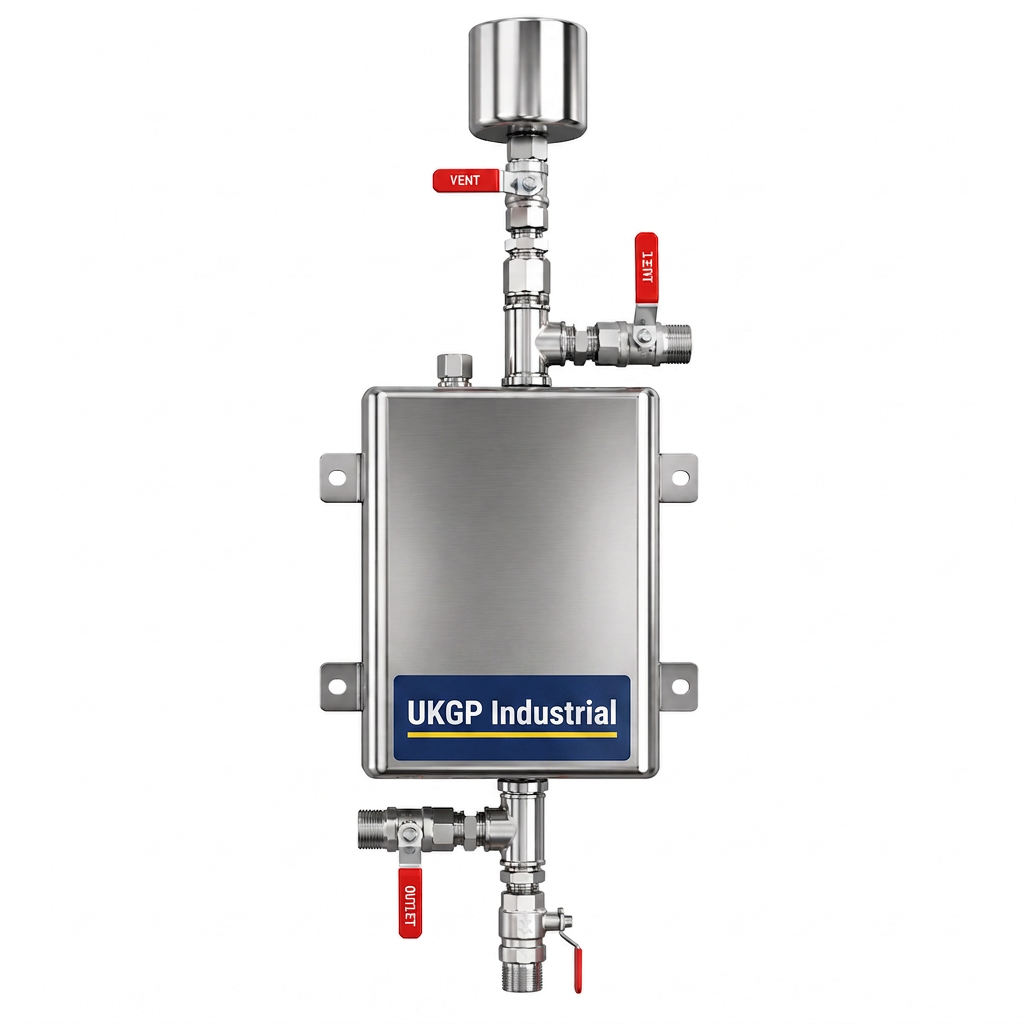
The selection between LLH and CCT also impacts the long-term maintenance regime as defined by BSRIA BG50. A low loss header, specifically one equipped with a drain valve and air vent, facilitates the collection of magnetite and sludge at a low-velocity point. This simplifies the flushing and cleaning processes. When using close coupled tees, the system must rely on separate dirt separators and air vents, which increases the number of potential leak points and complicates the commissioning process.
From a pumping energy perspective, an incorrectly sized close coupled tee arrangement can lead to significantly higher operational costs. If hydraulic separation is not perfect, pumps will 'fight' each other, leading to operation outside of their preferred curve. This increases electrical consumption and reduces the Mean Time Between Failure (MTBF) for pump seals and motors. For FM managers, the LLH provides a clearly defined 'test point' where temperatures can be monitored on both sides of the header to diagnose circuit imbalances quickly.
Frequently asked questions
What is the maximum distance between close coupled tees?
- CIBSE AM15 indicates that for close coupled tees to be hydraulically neutral, the distance between the flow and return tees must not exceed three times the pipe diameter (3D). Wider spacing increases the pressure drop across the common pipe, leading to parasitic flow in the secondary circuit.
When should I choose a low loss header over close coupled tees?
- Generally, LLHs are preferred for boilers with low internal water content and high flow requirements, as they provide better protection against flow fluctuations. Close-coupled tees are often sufficient for high-mass boilers or smaller commercial installations where space is at a premium and the primary pump is sized to handle some secondary influence.
Can a low loss header act as a dirt separator?
- Yes. Many modern LLHs, such as those from UKGP Industrial, incorporate internal baffles or magnetic inserts to facilitate air and dirt separation. This eliminates the need for separate inline separators, reducing plant room footprint and installation costs.
What are the risks of an incorrectly sized low loss header?
- Common issues include 'thermal short-circuiting' where primary water bypasses the secondary circuit due to poor sizing, and velocity-related noise. BSRIA BG29/21 also notes that stagnant pockets in oversized headers can become breeding grounds for bacteria or focal points for corrosion if water treatment is not maintained.