Identifying the Core Causes of Temperature Divergence
When a plant room is commissioned, the primary objective is to maintain a stable flow temperature from the primary circuit into the secondary headers. Temperature loss occurs when the flow temperature exiting the LLH towards the emitters is significantly lower than the flow temperature entering from the boilers. This is rarely a fault of the heat source itself; rather, it is a symptom of hydraulic bypass. In a perfectly balanced system, the primary flow rate should slightly exceed the secondary flow rate, ensuring that the secondary circuit always has access to high-grade heat.
If the secondary pumps are oversized or running at constant speed while the primary circuit modulates down, the secondary circuit begins to 'pull' water from the return leg of the header to satisfy its flow requirement. This mixing of hot flow and cool return water within the header body results in a diluted flow temperature (the 'blending' effect). This not only reduces the temperature available to the building but also raises the return temperature to the boilers, potentially preventing condensing boilers from operating in their most efficient mode.
- Primary flow rate vs. secondary flow rate imbalance.
- Laminar flow disruption within the header body.
- Excessive sludge or magnetite accumulation reducing effective volume.
- Incorrect sensor placement leading to BMS 'hunting'.
Primary vs. Secondary Flow Imbalance
The most common culprit for temperature loss is a secondary flow rate that exceeds the primary flow. According to CIBSE AM14, the low loss header should act as a neutral point of pressure. If the secondary pump is pulling 15 m³/h while the primary pumps are only delivering 12 m³/h, the additional 3 m³/h must come from the return leg. This results in the secondary flow temperature dropping as it is tempered by the 40°C or 50°C return water.
To troubleshoot this, engineers must verify the pump curves and commissioning data. Utilizing UKGP Industrial low loss headers ensures that the internal chamber is sized correctly to maintain low velocities (typically below 0.5 m/s), which allows for proper thermal stratification. If you find the secondary flow is too high, the variable speed drives (VSDs) on the distribution pumps should be adjusted to better match the heat source's output, or the boiler primary pumps should be ramped up if the system allows.
- Secondary flow rate (Q2) > Primary flow rate (Q1) = Mixing/Temperature Drop.
- Primary flow rate (Q1) > Secondary flow rate (Q2) = Increased Return Temp/Reduced Delta-T.
Selecting the Correct Header for Hydraulic Neutrality
Sizing a header based solely on pipe diameter is a frequent error in commercial retrofits. An undersized header increases water velocity, which prevents the hydraulic decoupling required for stable temperatures. When velocity exceeds 0.5 m/s within the header, the kinetic energy of the incoming water disrupts the 'neutral zone,' causing turbulence and forced mixing. This turbulence makes it impossible for the secondary flow to reliably draw only from the hot primary supply.
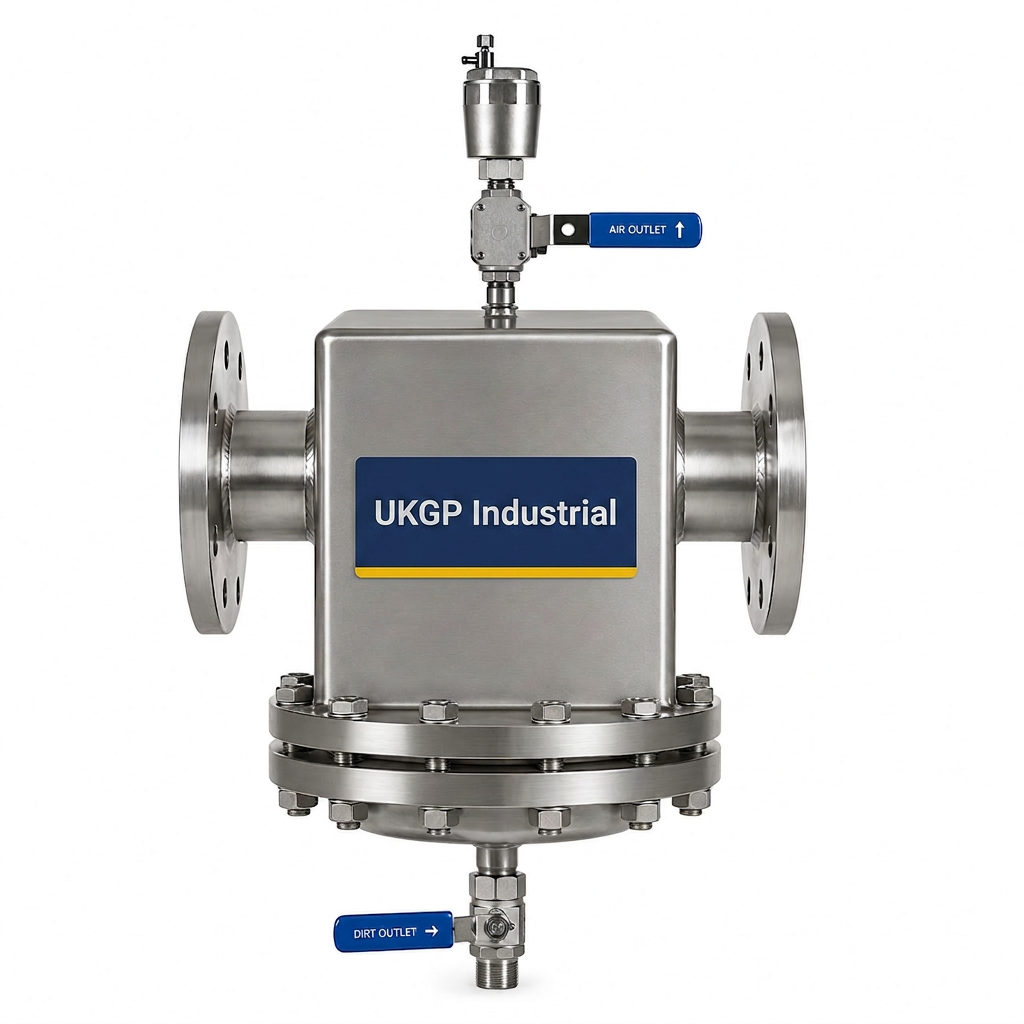
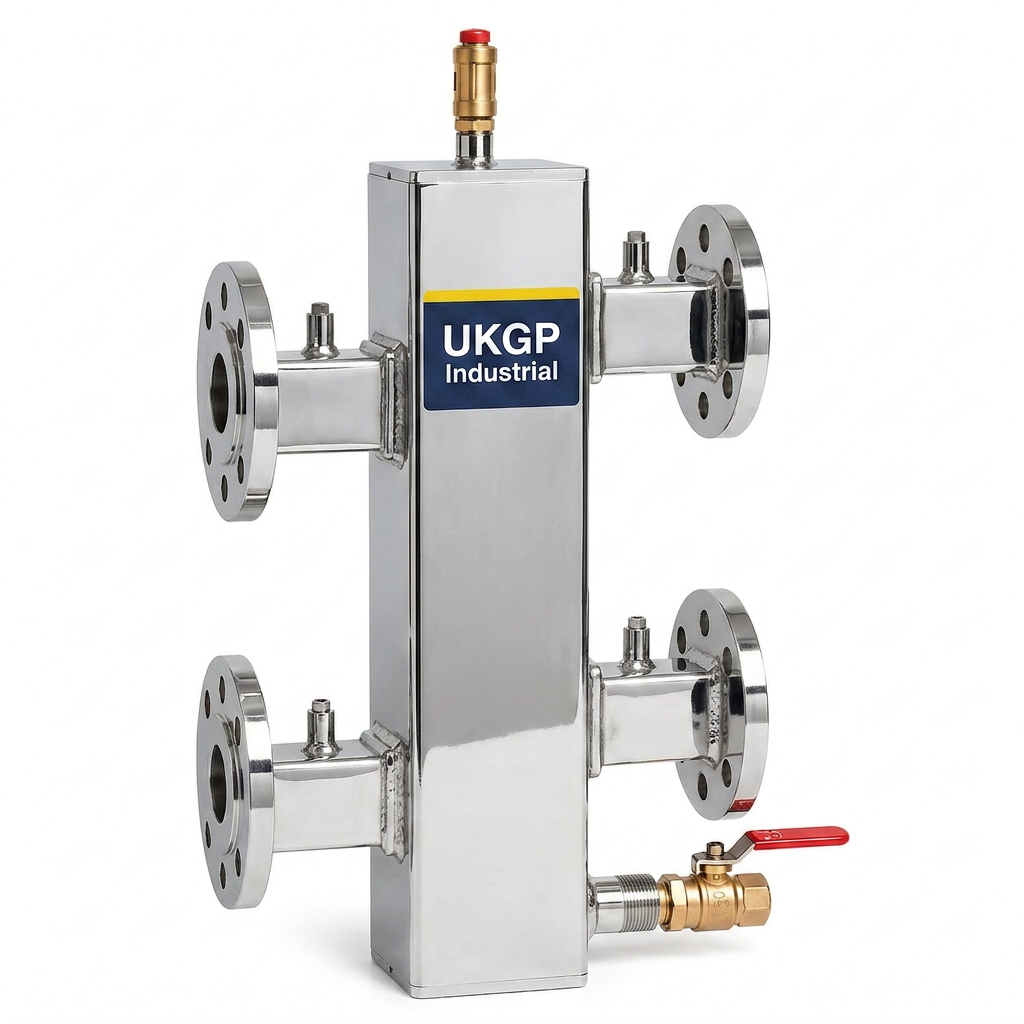
A correctly specified UKGP Industrial low loss header provides sufficient volume to act as a buffer and a settling zone. This volume allows air to rise to the automatic air vent (AAV) and dirt to settle at the bottom drain valve. If the header is too small for the peak kW load of the plant room, the pressure drop across the unit increases, and the temperature gradient becomes unstable. Engineers should always size the LLH based on the maximum flow rate (m³/h) rather than the nominal boiler outlet size.
The Impact of Debris and Magnetite on Thermal Transfer
Internal fouling of the low loss header can lead to significant 'hot spots' or 'dead zones.' While the LLH provides some level of separation, it is not a substitute for dedicated magnetic filtration. Over time, magnetite can settle in the bottom of the header, effectively reducing its internal volume and increasing the velocity of the water passing through the remaining space. This 'choking' effect contributes to the temperature loss issues mentioned previously.
Furthermore, if the system lacks adequate air and dirt separation, air bubbles can become trapped at the top of the header. This air pocket acts as an insulator, particularly if the temperature sensor is located in the upper portion of the vessel. The sensor may read a lower temperature than the actual water flowing through the pipework, causing the BMS to call for more heat and leading to short-cycling of the boilers. Proper maintenance per BSRIA BG50 is essential to ensure the hydraulic characteristics of the header remain consistent over its service life.
- Oxygen ingress leading to haematite (red rust).
- Anaerobic conditions leading to magnetite (black sludge).
- Thermal conductivity interference on sensor pockets.
Sensor Placement and BMS Integration Errors
The placement of the header sensor (often referred to as the 'common' or 'system' sensor) is critical for accurate temperature control in modern cascaded systems like those from Worcester or Viessmann. If the sensor is placed too close to the primary flow inlet, it may register a higher temperature than is actually being delivered to the secondary circuit. Conversely, if it is placed too low, it may be influenced by the cooler return water.
In many cases, 'temperature loss' is actually a measurement error. An uninsulated sensor or one that is not properly seated in its thermal pocket will read lower than the actual fluid temperature. This leads to the boiler plant working harder than necessary, increasing wear and tear. Use a high-quality thermal paste in the dry pocket and ensure the pocket is located in the upper third of the header body—specifically in the flow's path but away from the immediate turbulence of the inlet nozzles.
Final Remediation and Best Practices
To rectify temperature loss, begin by measuring the Delta-T across the boilers and the Delta-T across the secondary load. If the secondary Delta-T is significantly lower than the primary, you have a flow imbalance. Re-balancing the system using the commissioning valves (as per CIBSE Commissioning Codes) is often the first step. If the header itself is undersized for a plant upgrade, it must be replaced with a unit capable of handling the increased flow volumes.
Finally, ensure the secondary circuit is not bypassing the header through a faulty three-way valve or an open bypass elsewhere in the system. A low loss header is a passive component; if it is 'failing' to deliver temperature, the cause is almost always the external hydraulic conditions or the quality of the water within it. Adhering to BSRIA BG29/21 for pre-commission cleaning and maintaining water chemistry will ensure the header functions as intended for the duration of the plant's life.
- Calculate the total m³/h for both circuits.
- Check for blocked strainers or fouled heat exchangers.
- Validate BMS sensor readings against a calibrated pipe-thermometer.
Frequently asked questions
What is the ideal flow ratio between primary and secondary circuits?
- BSRIA BG29/21 standards suggest that if the primary circuit is clean but the header shows temperature drop, secondary flow rates exceed primary supply. Ideally, the LLH should be sized so the primary flow is 10% greater than the secondary.
Can incorrect orientation cause temperature loss?
- Yes, if the LLH is installed horizontally, internal laminar flow may be disrupted, leading to poor mixing or air pocketing. Always ensure the LLH is installed vertically unless it is a bespoke design engineered for horizontal orientation.
Why is my secondary flow temperature lower than the boiler flow temperature?
- If the secondary flow rate is higher than the primary, cool return water from the system is drawn back into the secondary flow pipework within the header, diluting the flow temperature. Check the pump speeds and balancing.
Where is the best place to locate the header sensor?
- Temperature sensors (NTC thermistors) should be placed in a dedicated dry pocket on the upper third of the header body, or immediately on the secondary flow pipework. Incorrect positioning leads to 'false' readings that cause the BMS to ramp boilers unnecessarily.