Understanding the micron and its impact on hydronic health
A micron (micrometre) is one-millionth of a metre. To put this in perspective, a human hair is roughly 70 microns, and the naked eye can generally see particles down to 40 microns. In a closed-loop heating or chilled water system, the most damaging particles are often those between 5 and 20 microns. These microscopic fragments of magnetite and haematite act as an abrasive paste, wearing down pump seals and eroding the seats of control valves, particularly PICVs (Pressure Independent Control Valves).
When selecting a micron rating, engineers must balance 'nominal' vs 'absolute' ratings. A nominal 5-micron filter might only capture 60-80% of particles at that size, whereas an absolute-rated filter will capture 99.9%. For most commercial plant rooms, nominal ratings are sufficient for general side stream applications, provided the circulation rate is adequate—typically 5-15% of the total system volume per hour as per industry best practice.
- Turbidity levels (NTU) and suspended solids (mg/l).
- The presence of high-efficiency, small-bore heat exchangers.
- System age and metallurgy (e.g., higher magnetite risk in older steel pipework).
- Maintenance frequency and site accessibility.
Matching media to component sensitivity
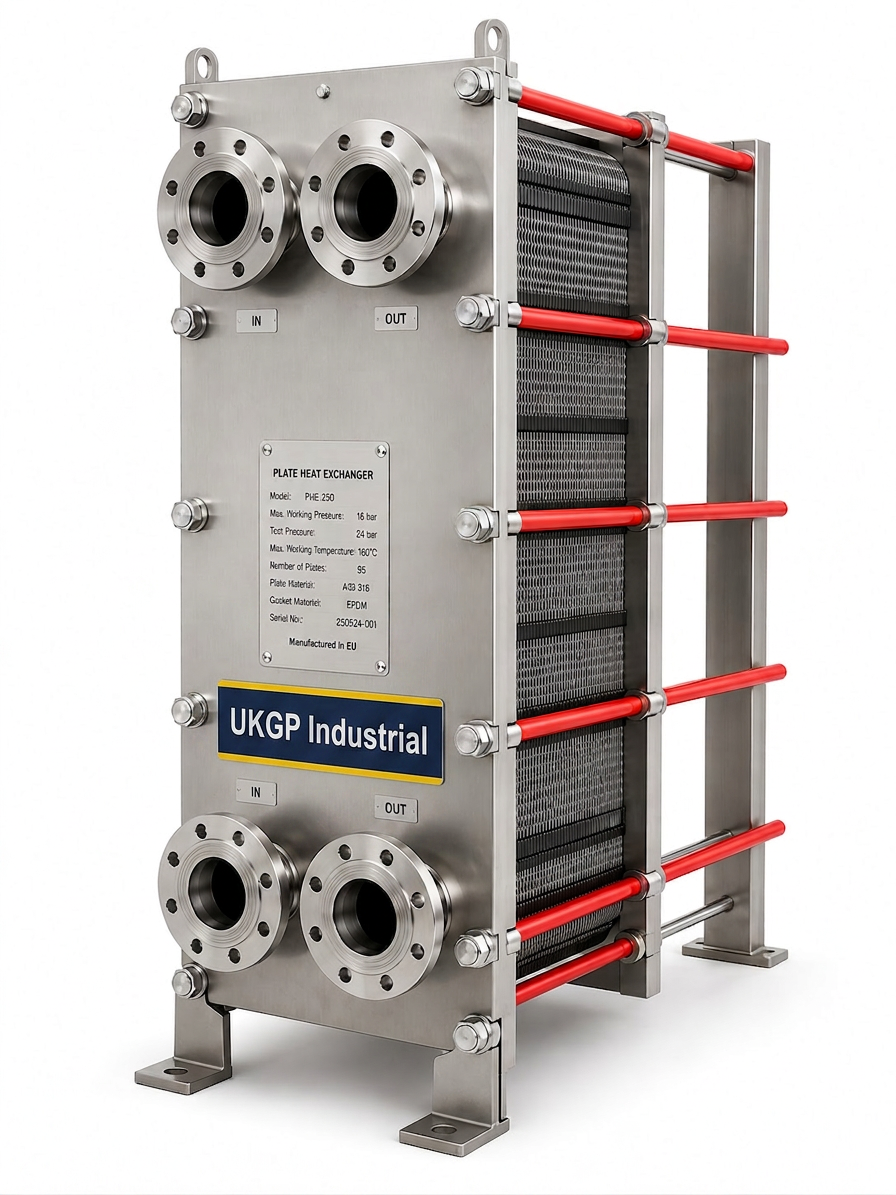
The sensitivity of the plant room components dictates the minimum filtration requirement. Modern condensing boilers and heat pumps often utilise compact, high-efficiency heat exchangers with narrow waterways. These components are highly susceptible to fouling. If the system incorporates a UKGP plate heat exchanger for hydraulic separation, maintaining a fine micron rating is vital to prevent the secondary side from becoming a debris trap, which would otherwise degrade heat transfer coefficients.
For systems dominated by traditional cast iron radiators and large-bore steel pipework, a 50-micron rating may be acceptable for bulk solids removal. However, the trend toward high-performance buildings means that 20 microns is increasingly seen as the baseline, with 5 microns preferred for chilled water circuits where biological 'slime' can bind with fine mineral solids to form stubborn deposits.
- 5-10 Microns: Essential for systems with plate heat exchangers and PICVs.
- 20-50 Microns: Suitable for larger bore industrial systems with robust components.
- 100+ Microns: Standard for 'roughing' filters or pre-commissioning stages.
The Trade-off: Filter life vs. water clarity
The relationship between micron rating and filter longevity is non-linear. Replacing a 50-micron bag with a 5-micron cartridge increases the surface area required to prevent rapid pressure drop. If a system has high levels of suspended solids, a 5-micron filter may blind within hours, leading to a 'service required' alarm on the BMS. This is a common pitfall in the UK FM sector, where under-resourced maintenance teams may eventually bypass the filter altogether if it requires too frequent intervention.
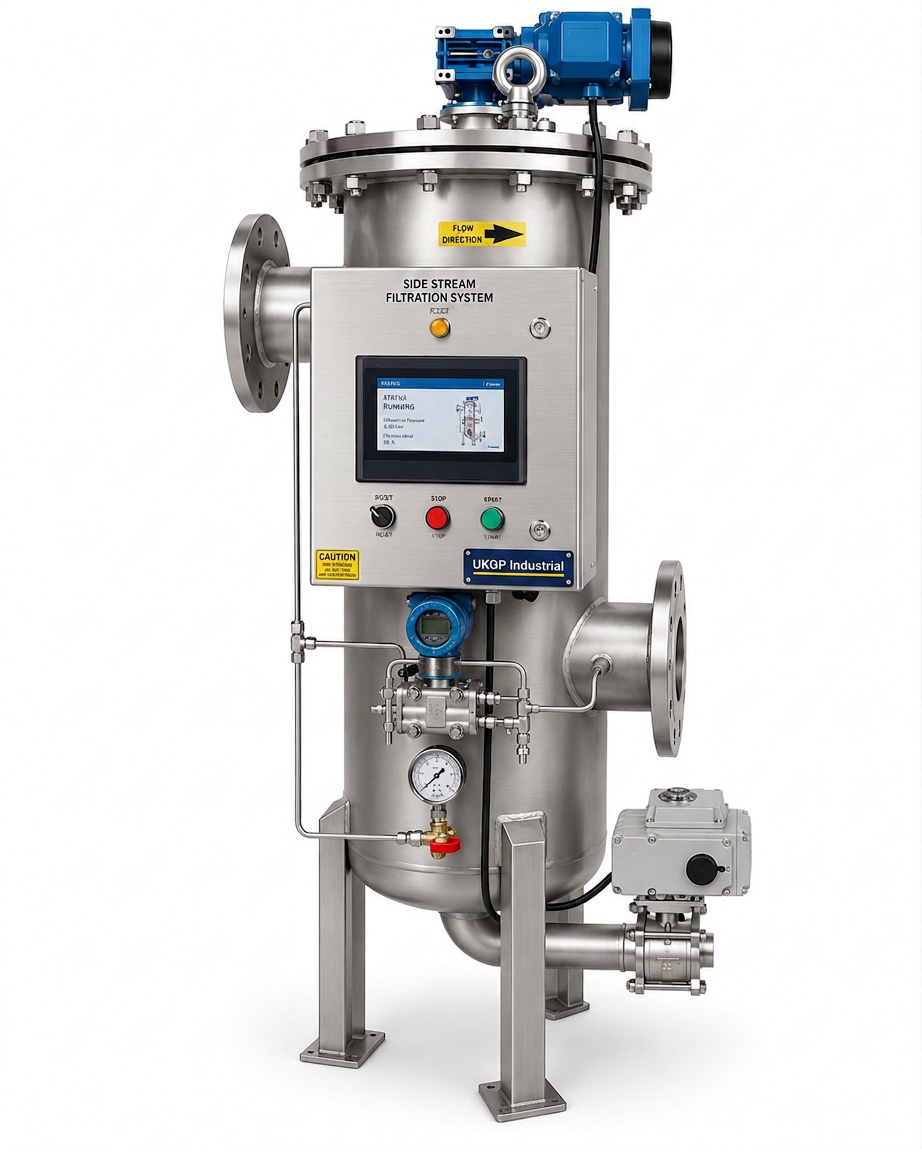
To mitigate this, the UKGP side stream filtration skid is designed to allow for staged filtration. In a heavily fouled or newly commissioned system, it is advisable to start with a 50 or 100-micron bag to remove the 'construction debris' and larger magnetite flakes. Once the water clarity improves (verified by a turbidity tube or laboratory analysis), the media should be stepped down to a 20 or 5-micron cartridge for long-term 'polishing' of the water.
Integration with secondary protection devices
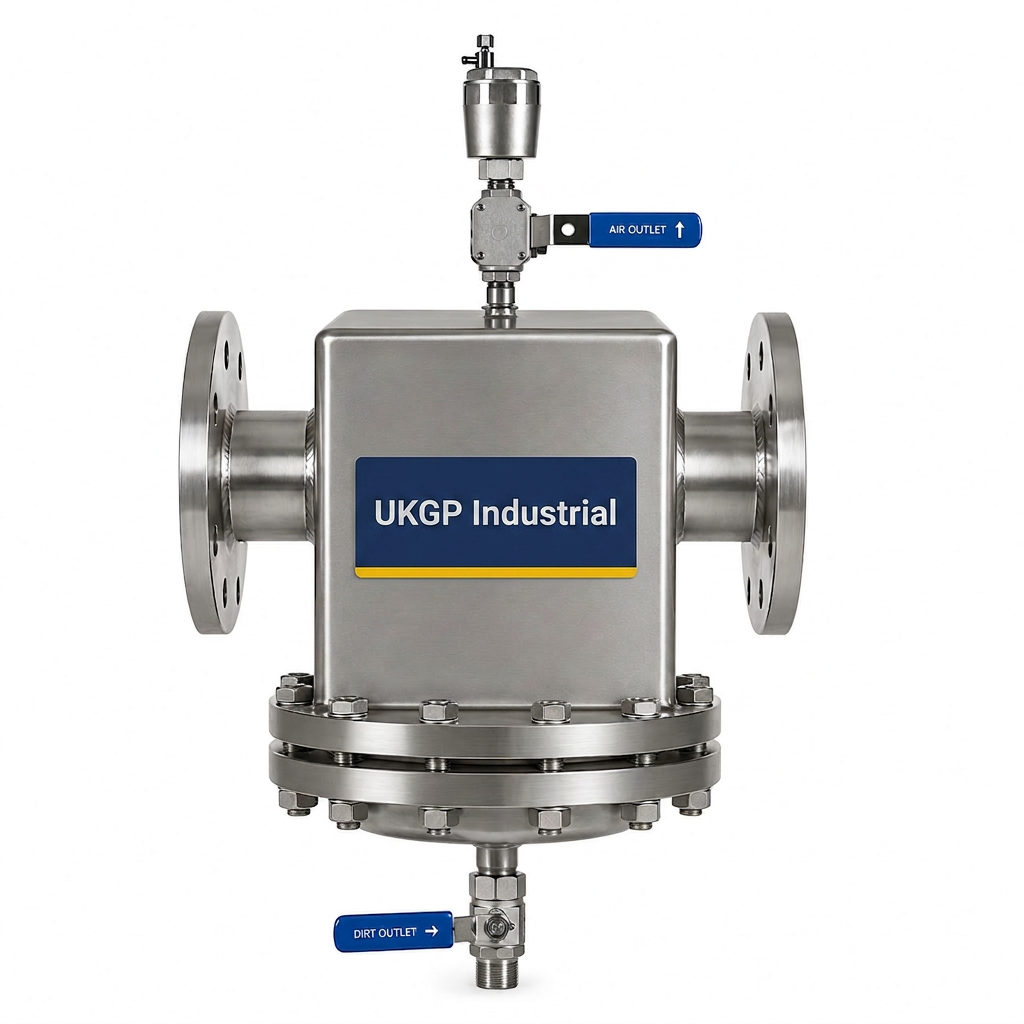
A side stream filter should never be the sole method of debris management. It works most effectively when integrated as part of a multi-stage strategy. In-line protection, such as a UKGP air & dirt separator, should be installed on the main flow to capture larger particles (typically >100 microns) and entrained air in a single pass. This reduces the 'heavy lifting' required by the side stream unit, allowing the finer micron media to last longer.
The side stream filter's role is to capture the finer, lighter particles that stay in suspension and bypass standard dirt separators. By using a coarse in-line separator and a fine 5-20 micron side stream unit, the engineer creates a comprehensive protection regime that meets the stringent requirements of BSRIA BG50. This dual-action approach is particularly critical in variable-speed systems where lower flow rates can lead to debris settling in low-flow areas if not actively filtered.
- Incorporate a UKGP air & dirt separator to handle bulk heavy particles and micro-bubbles.
- Position the side stream filter across the pumps or on the return header.
- Use 5-micron media for the final 'steady state' phase of the building life cycle.
Commissioning and BSRIA BG29/21 compliance
BSRIA BG29/21 emphasises the importance of cleanliness from the outset. During the pre-commission cleaning phase, the side stream filter is often used to accelerate the flushing process. However, using a 5-micron filter during the initial flush is counterproductive. The high volume of swarf, scale, and silica found in new installations will immediately overwhelm fine media.
The recommended approach is to utilise 100-micron bags during the dynamic flushing and chemical cleaning stages. Only after the system has been thoroughly flushed, passivated, and the water is visually clear should the engineer transition to the final micron rating. Proper documentation of these media changes is essential for the O&M manuals and provides a clear audit trail that the system has been handed over in a condition that will prevent premature component failure.
Frequently asked questions
Is a 5-micron filter always better than a 50-micron filter?
- A 5-micron filter provides superior water clarity but requires more frequent media changes. High-pressure heating systems often benefit from starting at 20-50 microns after commissioning, eventually stepping down to 5 microns once the system is 'clean' to maintain long-term stability.
How do I know when the filter media needs changing?
- Monitor the pressure differential (ΔP) across the filter housing. Most UKGP side stream filtration skids include gauges for this purpose. A significant rise in ΔP indicates the media is blinded and requires replacement or backwashing.
Can I stop using chemicals if I have a high-efficiency filter?
- No. Side stream filtration is a physical removal process. You must still maintain chemical inhibitor levels (e.g., to BSRIA BG50 standards) to prevent the underlying corrosion that creates the debris in the first place.
What rating should I use for a retrofit on an old system?
- For retrofits on old, heavily fouled systems, start with a coarse bag (100+ microns) to remove 'heavy' debris quickly. Moving straight to a 5-micron cartridge will lead to instant blinding and excessive maintenance costs.