Mechanical Fundamentals and Movement Types
The primary function of an expansion joint is to absorb the dimensional changes of pipework caused by thermal expansion or contraction. In UK building services, this is governed by the coefficient of linear expansion for the specific pipe material—typically 0.012 mm/m/°C for carbon steel and 0.017 mm/m/°C for copper. Engineers must calculate the 'free expansion' of a pipe run between two fixed points (anchors) before selecting a bellows with a sufficient working stroke.
It is essential to distinguish between the four primary movement modes: axial, lateral, angular, and universal. Axial movement is the most common in long straight runs, whereas lateral and angular movements are typically addressed where pipework changes direction. Specifiers must also account for 'installation gap' and 'cold pull' requirements to ensure the bellows operates within its rated convolution limits during both peak operating temperatures and shutdown conditions.
- Axial: Compression or extension along the longitudinal axis.
- Lateral: Offset movement perpendicular to the axis.
- Angular: Bending of the bellows in a single plane.
- Universal: A combination of axial, lateral, and angular movements.
Specifying Rubber Expansion Joints for HVAC
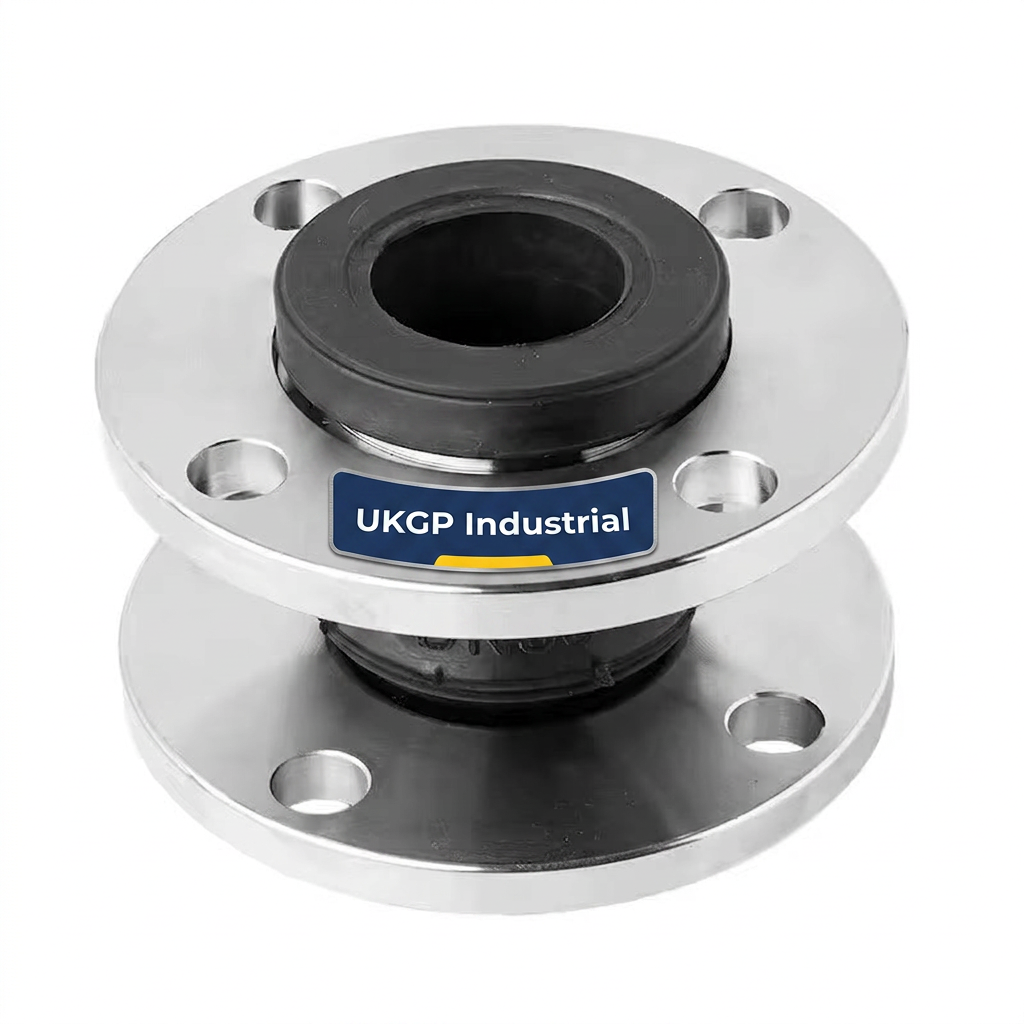
Rubber expansion joints are the industry standard for LTHW (Low Temperature Hot Water), CHW (Chilled Water), and condenser water systems. Their primary advantage lies in their multi-directional flexibility and superior acoustic damping properties. According to BSRIA BG50 guidelines, rubber bellows are effective at isolating high-frequency noise and vibration generated by centrifugal pumps and chillers, preventing the transmission of structure-borne sound through the building fabric.
When specifying rubber units, material choice is paramount. EPDM is standard for water-based systems, but if there is a risk of oil contamination or for fuel lines, Nitrile (NBR) must be used. Engineers should be wary of EPDM limitations regarding chemical additives used in BSRIA BG29 pre-commission cleaning; high concentrations of certain biocides or dispersants can degrade the elastomer if not thoroughly flushed. Integrated tie-bars (limit rods) are mandatory in many installations to prevent the bellows from extending beyond its limit if an anchor fails.
- Single-sphere or double-sphere EPDM/Nitrile membranes.
- Nylon or aramid cord reinforcement for pressure retention.
- BS EN 1092-1 PN16 or PN25 carbon steel swivel flanges.
- Integrated tie-bars to prevent over-extension.
Metal Expansion Bellows and EN 14917 Compliance
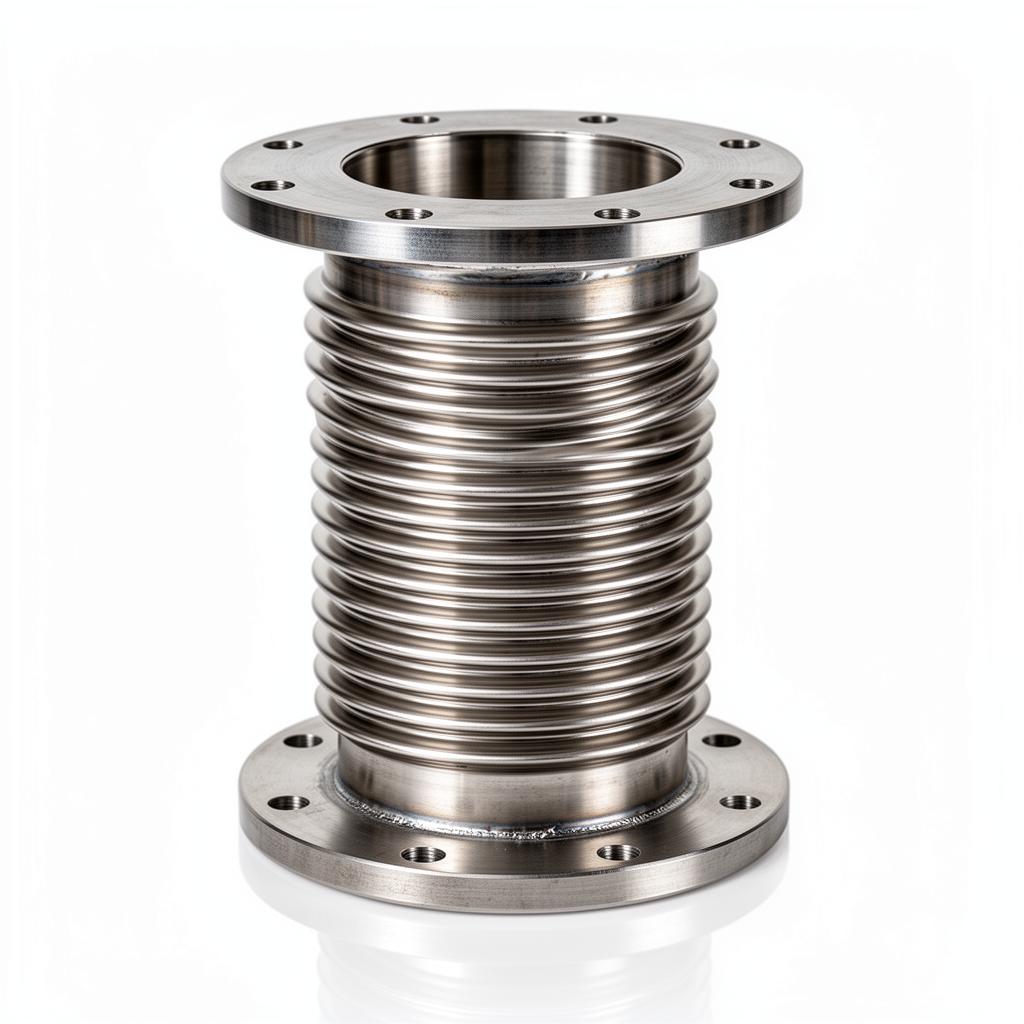
For high-pressure LTHW, MTHW, or steam systems where temperatures exceed the 100°C threshold of rubber, metallic expansion bellows are required. Design and manufacture should adhere to EN 14917 (the European standard for metal bellows expansion joints) or the Expansion Joint Manufacturers Association (EJMA) standards. Unlike rubber, metal bellows have a finite fatigue life, meaning they are designed for a specific number of thermal cycles (typically 1000, 2000, or 5000 cycles for building services).
The core component of a metallic joint is the thin-walled, corrugated element, usually manufactured from grade 321 or 316L stainless steel. For district heating applications or systems with high flow velocities, internal liners are essential to prevent 'reed resonance' and erosion. Furthermore, metal bellows are significantly stiffer than rubber equivalents, meaning the calculated 'spring rate' must be included in the anchor load calculations to ensure the structural fixings can withstand the force required to compress the bellows.
- Multi-ply bellows construction for high fatigue life.
- Stainless steel grades 304, 321, or 316L for corrosion resistance.
- Internal liners to reduce turbulence and erosion.
- External shrouds for protection against mechanical impact.
Anchoring and Guiding: The Installer’s Responsibility
The most frequent cause of expansion bellows failure is improper anchoring and guiding. When a bellows is pressurised, it acts like a piston, attempting to push the pipework apart. This force, known as 'pressure thrust', can be substantial—often several tonnes in large diameter pipework. Main anchors must be designed by a structural engineer to resist the sum of the pressure thrust, the bellows spring rate, and any frictional forces from pipe supports.
Guiding is equally critical, particularly for axial expansion joints. Without proper alignment, the pipework may buckle or 'squirm' under load. Standard practice dictates that the first guide be placed within four pipe diameters (4D) of the joint, and the second guide within fourteen diameters (14D). Failure to follow this sequence, as outlined in CIBSE Guide C, often results in the bellows being subjected to lateral loads for which it was not designed, leading to premature convolution cracking.
- Main Anchors (MA): Designed to withstand full pressure thrust and spring rate.
- Intermediate Anchors (IA): Used to divide long runs into manageable segments.
- Primary Guides: Located within 4 pipe diameters of the bellows.
- Secondary Guides: Located within 14 pipe diameters to prevent bowing.
Maintenance and Lifecycle Management according to BG50
Expansion bellows should be treated as 'wear parts' within a plant room. BSRIA BG50 (Water Treatment for Closed Heating and Cooling Systems) emphasizes the importance of regular inspection to prevent catastrophic leaks. Rubber bellows typically have a service life of 7 to 10 years, though this can be drastically shortened by exposure to UV light, ozone, or incorrect chemical dosing. Any signs of 'crazing' or surface hardening indicate the elastomer has lost its resilience and requires immediate replacement.
For metallic bellows, maintenance focuses on the integrity of the convolutions and the bellows' ability to move freely. Accumulated debris between the convolutions can restrict movement, causing the bellows to fail prematurely due to localized stress. Engineers should also ensure that pipework insulation does not pack the convolutions so tightly that thermal movement is restricted. In district heating applications, leak detection sensors integrated into the bellows assembly can provide early warning of failure in inaccessible locations.
- Visual inspection for 'ballooning' or surface cracking in rubber.
- Checking for 'bottoming out' of convolutions in metal joints.
- Verifying tie-bar nut clearance during operating temperature.
- Inspection of anchors for signs of movement or bolt shearing.
Practical Installation Best Practices
During the installation phase, M&E contractors must ensure that the bellows is not used to bridge gaps caused by poor fabrication. Forcing a bellows into position introduces 'pre-stress', which consumes the design movement safety margin. For rubber bellows with swivel flanges, ensure the bolts are inserted from the 'bellows side' to prevent the bolt shanks from rubbing against the rubber membrane as it expands.
Final commissioning should include a 'hot check' once the system reaches operating temperature. Tie-bar nuts should be checked to ensure they are not binding, and the bellows should be visually inspected to confirm it has compressed or extended as predicted. If a system is being pressure tested beyond its working pressure, temporary 'test bars' may be required to prevent the bellows from over-extending, as the design anchors may not have been sized for the higher test pressure.
- Verify flange drilling matches (BS EN 1092-1 PN16 is standard).
- Do not paint rubber bellows; solvents can damage the membrane.
- Use backing flats or washers to prevent bolt heads from damaging rubber.
- Ensure flow direction arrows (where applicable) are followed.
Frequently asked questions
Can expansion bellows be used to compensate for misaligned pipework?
- Expansion bellows should never be used to correct significant pipework misalignment. Pipes must be properly aligned prior to installation to ensure the bellows operates within its design stroke. Misalignment induces torsional stress which significantly reduces fatigue life.
How do I choose the correct elastomer for rubber bellows?
- Nitrile (NBR) is preferred for oils and gas, EPDM for standard LTHW and CHW systems, and Butyl or Viton for higher temperatures or specific chemical resistances. Always check compatibility with water treatment chemicals used during BSRIA BG29 flushing.
When should I specify stainless steel over rubber?
- While rubber bellows provide superior vibration isolation, stainless steel bellows are required for higher temperatures (typically >100°C), higher pressures, or where fire-safe components are mandated by insurance or building regs.
What are the typical temperature and pressure limits?
- Standard EPDM rubber bellows are typically rated for 10-16 bar at 90°C. Metal bellows can be engineered for much higher pressures (PN25, PN40+) and temperatures exceeding 500°C depending on the alloy and laminate construction.
Is an internal flow liner necessary?
- Internal sleeves (liners) are recommended when flow velocities exceed 5m/s for liquids or 20m/s for gases to prevent flow-induced vibration and erosion of the bellows convolutions.