Regulatory Framework and Standards
In the UK building services sector, the design and maintenance of water systems are governed heavily by BSRIA guidelines. Specifically, BG50/2021 highlights the necessity of maintaining correct chemical concentrations to prevent corrosion and scale. Chemical dosing pots provide the primary means of introducing corrosion inhibitors, biocides, and glycol into closed circuits without the need for system depressurisation.
Failure to adhere to these standards often results in the premature failure of heat exchangers, circulators, and control valves. The dosing pot must be rated to the system's maximum working pressure—typically 10 bar or 14 bar in UK commercial plant rooms—and equipped with appropriate safety features including non-return valves and tundishes to prevent backflow and environmental contamination.
- BS EN 12828: Heating systems in buildings.
- BSRIA BG29/21: Pre-commission cleaning of pipework systems.
- BSRIA BG50/2021: Water treatment for closed heating and cooling systems.
- HSE HSG274: Control of legionella bacteria (relevant for process water).
Primary Piping Configurations
The most effective piping arrangement for a chemical dosing pot is to install it across a point of high differential pressure. This ensures that when the isolation valves are opened, the system pressure force-flushes the contents of the pot into the main circulation. Typically, the inlet of the dosing pot is connected to the flow header (high pressure) and the outlet to the return header (lower pressure).
A common error in plant-room design is piping the dosing pot as a dead-leg or on a bypass with insufficient pressure drop. If the differential pressure is less than 0.2 bar, the dosing pot may fail to evacuate fully, leading to chemical stratification. For systems with variable speed pumps, engineers must ensure that the dosing pot remains functional even when the pumps are operating at minimum speed.
- Piping the pot across the main flow and return headers.
- Installing across the primary circulating pump.
- Using a dedicated bypass loop within a sub-circuit.
Core Components and Safety Features
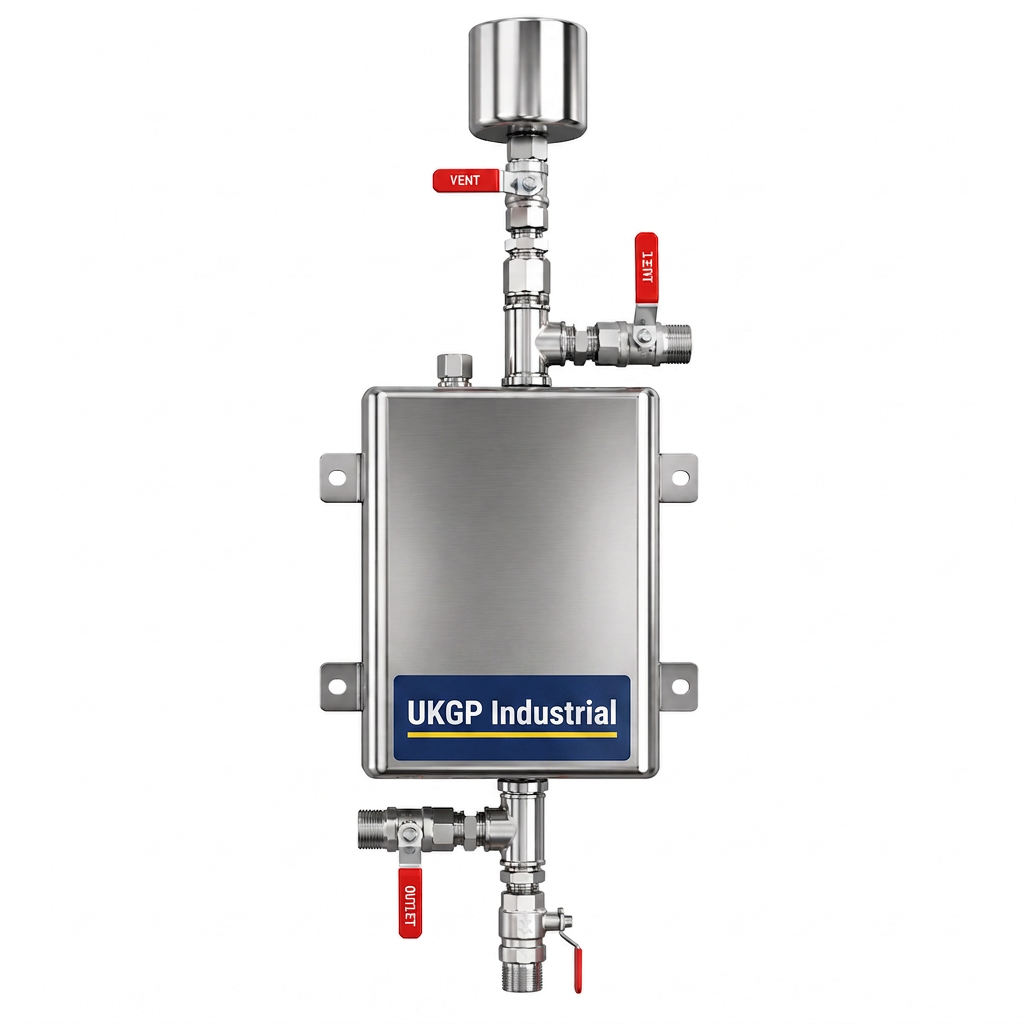
A standard UKGP Industrial dosing pot kit includes four essential valves. The filling valve at the top must be of a robust design to withstand frequent operation. The drain valve at the base is used to empty the pot of water before chemicals are added, and this should always be piped to a foul drain via an air-gap (tundish) to comply with local water bylaws and prevent cross-contamination.
Modern specifications increasingly call for the inclusion of non-return valves (NRVs) on the inlet and outlet lines. These prevent back-siphoning and ensure that Once the dosing process is complete, the chemical is forced in a single direction into the system. High-quality air vents are critical; if air is trapped in the pot during the refilling process, it will be introduced into the closed circuit, exacerbating oxygen-driven corrosion—exactly what the inhibitors are designed to prevent.
- Inlet and outlet isolation valves (6mm to 25mm depending on pot size).
- Top-mounted filling funnel with integrated ball valve.
- Bottom-mounted drain valve piped to a tundish.
- Air vent/bleed valve at the highest point of the pot.
Operational Sequence for Dosing
The mechanical operation of a dosing pot must follow a strict sequence to maintain system integrity. Before opening the filling funnel, the pot must be isolated from the high-pressure system. If the drain valve is opened while the system isolation valves are still open, the plant room will suffer immediate depressurisation and potential flooding. Professional signage indicating the 'Open/Close' sequence should be permanently fixed near the pot.
For glycol introduction, the volume of the dosing pot must be calculated against the total system volume. In larger systems, multiple 'shots' may be required. Engineers should monitor the system pressure gauge during this process; if the system pressure drops significantly during the drain phase, the pressurisation unit may trigger a low-pressure alarm or lockout. Automatic pressurisation units often need to be temporarily inhibited during manual dosing operations.
- Close the inlet and outlet isolation valves.
- Open the drain valve and air vent to empty the pot.
- Close the drain valve.
- Fill the pot with chemical via the funnel.
- Close the fill valve and air vent.
- Open the inlet and outlet valves to flush into the system.
Installation Best Practices and Siting
Siting the dosing pot is as important as the piping arrangement. It should be located in a well-lit, accessible part of the plant room, typically near the primary pumps or the pressurisation unit. It should not be installed in a way that requires the operator to use ladders while carrying chemicals; floor-standing models or wall-mounted pots at chest height are preferred for health and safety compliance.
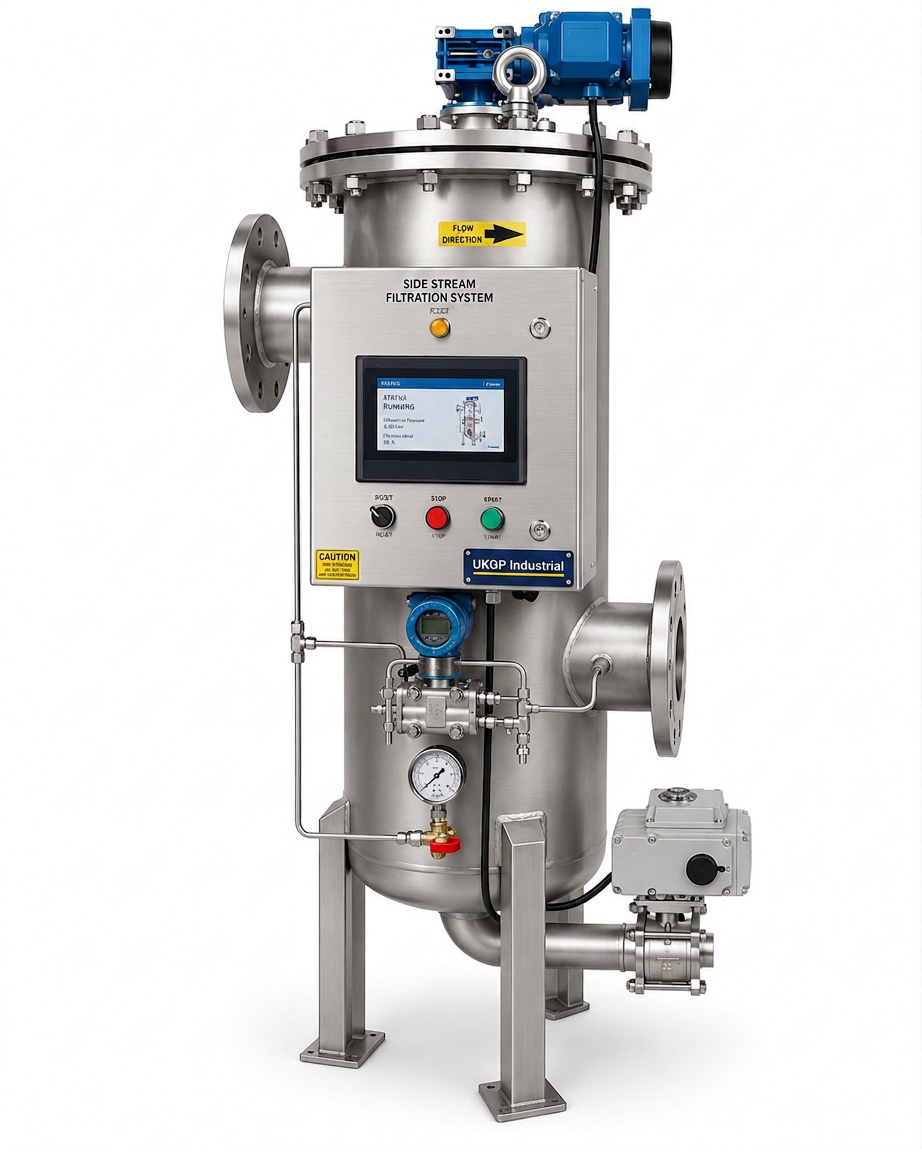
When integrating a dosing pot with side-stream filtration, the pot should ideally be piped upstream of the filter or as an integral part of the filtration skid. This allows the newly introduced chemicals to be filtered for any particulates they might have dislodged. All connecting pipework should be stainless steel or heavy-gauge copper to resist the undiluted chemical concentrations present within the pot’s immediate circuit.
- Locate the pot between the flow and return.
- Inlet connection: 15mm or 20mm copper/steel.
- Outlet connection: Same diameter as inlet.
- Ensure the pot is wall-mounted or floor-mounted with adequate support.
Maintenance and Lifecycle Management
Chemical dosing pots are pressure vessels and fall under the Pressure Systems Safety Regulations (PSSR) 2000 in certain industrial applications. While many commercial LTHW installations fall below the P-V threshold for mandatory annual inspections, it is good practice to include the dosing pot in the annual plant-room maintenance schedule. Corrosion at the weld points or around the valve threads is the most common cause of failure.
Over time, chemical residues can build up and block the 15mm or 20mm bypass pipework. Periodic flushing with clean water, separate from the chemical dosing cycle, can help clear these obstructions. If the pot is installed in a chilled water system (CHW), it must be fully insulated with closed-cell phenolic foam or similar to prevent condensation and external pipework corrosion, ensuring the valves remain operable through the insulation jacket.
- Quarterly inspection of all valve glands for leaks.
- Verification of the air vent operation.
- Cleaning of the filling funnel to remove chemical residue.
- Checking the integrity of the wall brackets or floor stand.
Frequently asked questions
How do I size a dosing pot for a commercial system?
- Per BSRIA BG50, dosing pots are generally sized based on 1% of the total system volume or the volume required for a single shot dose of inhibitor. Standard UK sizes range from 3.5 to 25 litres. For very large systems, bypass feeders or automated skids are preferred.
What are the risks of poor piping arrangements?
- Incorrect piping that creates a permanent bypass can lead to 'dead legs' or inefficient chemical distribution. If the differential pressure between the flow and return connection points is insufficient, the pot will not flush properly, leaving concentrated chemicals settled at the bottom.
Can I use a dosing pot in conjunction with side-stream filtration?
- Yes, many specifiers now prefer side-stream filtration units that incorporate a dosing pot functionality. This ensures that while chemicals are introduced, suspended solids (magnetite) are simultaneously removed, satisfying both BG29 and BG50 requirements.
What material should the dosing pot be constructed from?
- Stainless steel is the industry standard for commercial dosing pots due to its resistance to corrosion from concentrated chemical additives. Mild steel options exist but are generally discouraged in modern specifications due to longevity concerns.