Design and Technical Specifications
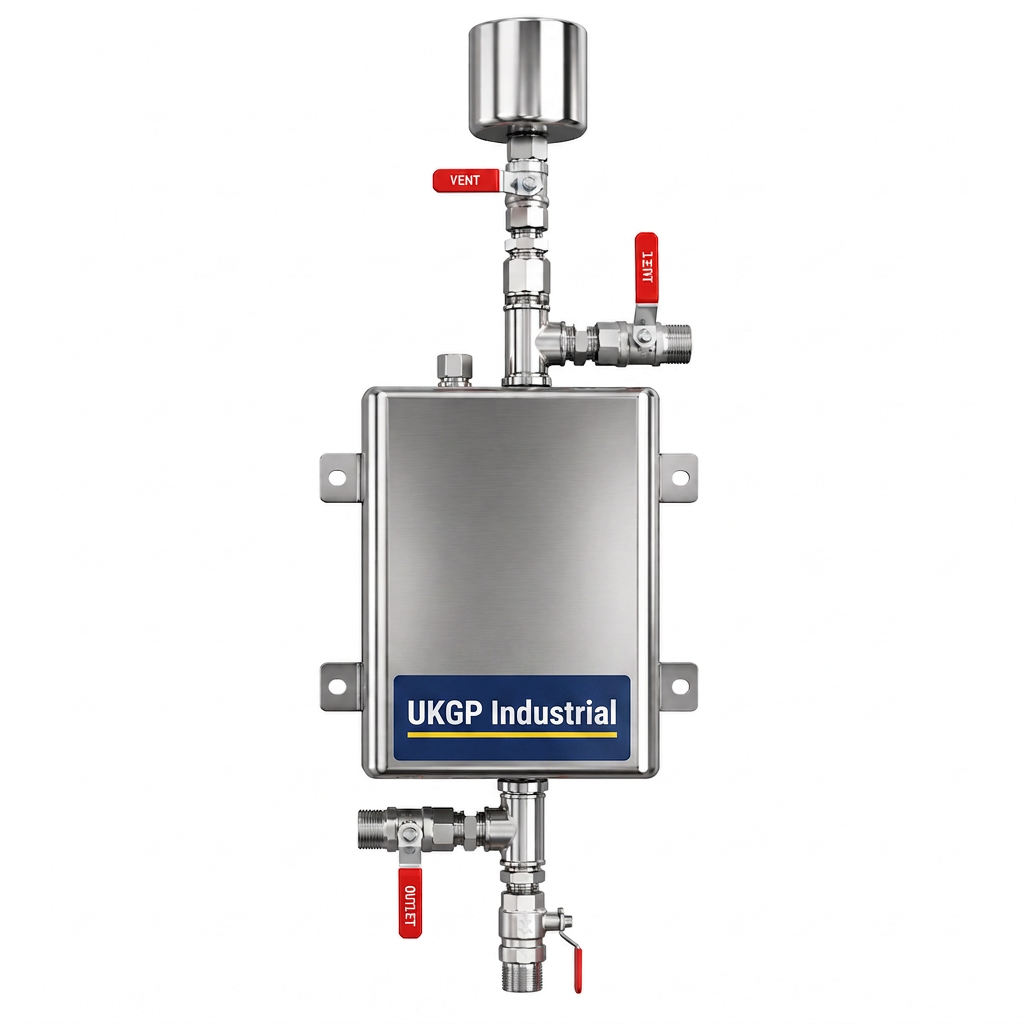
A chemical dosing pot is technically defined as a pressure vessel. Under the Pressure Equipment Regulations (PER), these units must be designed to withstand the maximum operating pressure of the system, typically with a safety margin. In the UK, most commercial plant rooms operate between 3 bar and 10 bar, though high-rise developments may require 16 bar or 25 bar rated vessels. UKGP Industrial dosing pots are constructed from stainless steel or heavy-gauge carbon steel to ensure resistance to both internal pressure and the corrosive nature of concentrated chemicals before they are diluted into the system.
The assembly must include essential valves: inlet and outlet isolation valves, a drain valve, and a filling valve capped with a tundish or funnel. A crucial safety feature is the air vent valve located at the top of the vessel. This allows the operator to bleed air during the filling process, ensuring the pot is completely hydraulic before it is opened to the system pressure. Failure to vent air can lead to 'water hammer' or compressed air pockets being introduced into the circuit, which can damage sensitive components like plate heat exchangers.
- Vessels must be manufactured to the Pressure Equipment Directive (PED) 2014/68/EU.
- Inclusion of a safety T-piece to prevent simultaneous closing of all valves.
- Installation of a non-return valve (NRV) to prevent backflow into the chemical funnel.
- Clear labelling of design pressure (PS) and test pressure (PT).
Installation and System Integration
Correct positioning of the dosing pot is vital for effective chemical distribution. It is typically installed across the flow and return headers, or across a pump, to utilise the differential pressure ($ΔP$) to drive the chemical into the main flow. The inlet of the dosing pot should be connected to the high-pressure side (usually the pump discharge or flow header) and the outlet to the low-pressure side (pump suction or return header). This ensures that once the valves are opened, the system pressure naturally flushes the contents of the pot into the circuit.
In accordance with BSRIA BG29/21 (Pre-commission cleaning) and BG50/2021 (Water treatment for closed systems), the dosing pot should be located in an accessible part of the plant room. It must be securely wall-mounted using heavy-duty brackets, as a full 25-litre pot adds significant weight. It is also recommended to install the pot in a location with adequate drainage to facilitate safe flushing and to manage any minor chemical spills during the filling process.
- Standard flow/return differential pressure.
- Across a secondary pump set.
- Across a control valve or orifice plate to increase the pressure drop.
Water Treatment and System Protection
The primary function of the dosing pot is the introduction of chemical inhibitors. These chemicals form a protective film on the internal surfaces of pipework and heat exchangers, preventing galvanic corrosion and the formation of magnetite ($Fe_3O_4$). In chilled water systems, the dosing pot is also the gateway for biocide dosing. Since chilled systems operate at temperatures conducive to pseudomonas and other bacterial growth, regular shock-dosing via the pot is a standard maintenance requirement under BG50 guidelines.
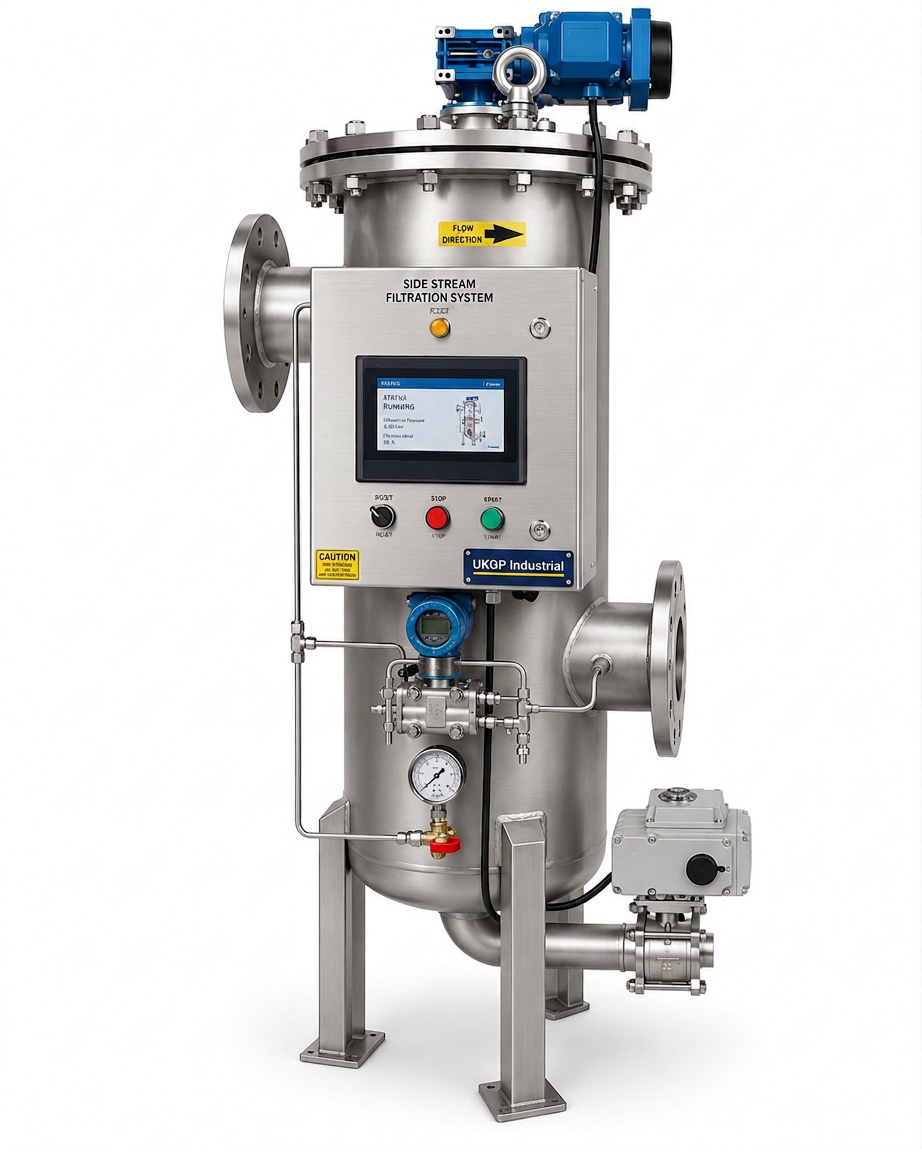
While dosing pots handle chemical entry, they should work in tandem with side-stream filtration. While the pot introduces the 'cure', the filter removes the 'cause' (suspended solids). For systems with high volumes of debris, relying solely on chemical dosing to passivate existing corrosion is insufficient. A combined strategy of controlled dosing via a stainless steel pot and active filtration ensures the system reaches the water quality targets specified in BS 8552.
Safe Operating Procedures
Operating a dosing pot requires strict adherence to a sequential valve operation to avoid scalding or chemical splashes. The most critical risk occurs when an operator attempts to open the fill valve while the vessel is still under system pressure. Consequently, all dosing pots must be fitted with a visible pressure gauge. Before any attempt is made to open the filling funnel, the operator must verify that the internal pressure is at 0 bar.
Protective Personal Equipment (PPE) is mandatory when handling concentrated inhibitors or biocides. Even though the dosing pot is a closed system once running, the manual filling process exposes the operative to raw chemicals. Once the chemical is loaded, the vessel must be fully primed with water and vented of air before opening the isolation valves. This prevents the 'slug' of air from entering the system, which could otherwise trigger high-point air locks or nuisance tripping of flow switches.
- Isolate the pot: Close inlet and outlet valves.
- Depressurise: Open the drain valve and the air vent slowly. Ensure the vessel is empty.
- Fill: Close the drain valve. Pour the chemical into the tundish and open the fill valve.
- Vent: Open the air vent until water/chemical reaches the top, then close the fill valve and vent.
- Inject: Slowly open the inlet and outlet valves to allow system flow to purge the pot.
Maintenance and Compliance (BG50)
BSRIA BG50/2021 emphasises that water treatment is an ongoing process, not a one-time event. Dosing pots should be inspected annually for signs of external corrosion, particularly around the welded joints and valve stems. The internal strainer (if fitted) should be cleaned to ensure no blockages impede the flow of chemicals into the system. All valves should be exercised to prevent seizing, particularly the drain valve which may accumulate sediment over time.
For facilities managers, record-keeping is a compliance necessity. Every time a system is dosed via the pot, the date, chemical type, and quantity must be logged. This data is essential for identifying high water-loss rates; if a system requires frequent inhibitor top-ups, it indicates an undiagnosed leak or excessive venting. Dosing pots from UKGP Industrial are designed for long-term serviceability, ensuring that maintenance teams can safely manage water quality throughout the building's lifecycle.
Frequently asked questions
How often should a closed-loop system be dosed via the pot?
- BSRIA BG50/2021 suggests that while there is no fixed interval, inhibitor levels should be tested at least annually. If the system has high water loss, more frequent dosing via the pot or an automated unit is required.
What is the maximum pressure rating for a standard dosing pot?
- Standard UKGP Industrial dosing pots are typically rated to 10 bar or 14 bar. Always check the nameplate. For high-rise applications or primary energy centres, high-pressure variants must be specified.
Can a dosing pot be used as a primary air vent?
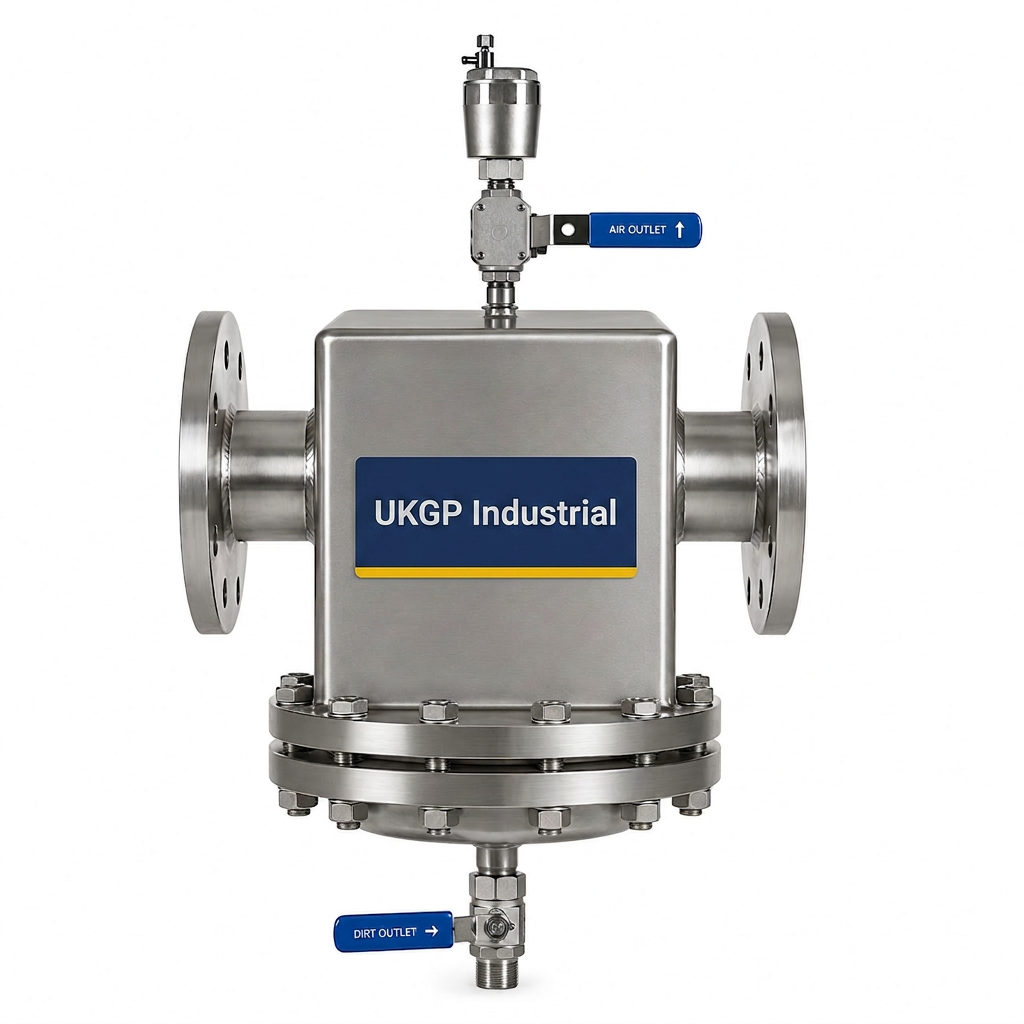
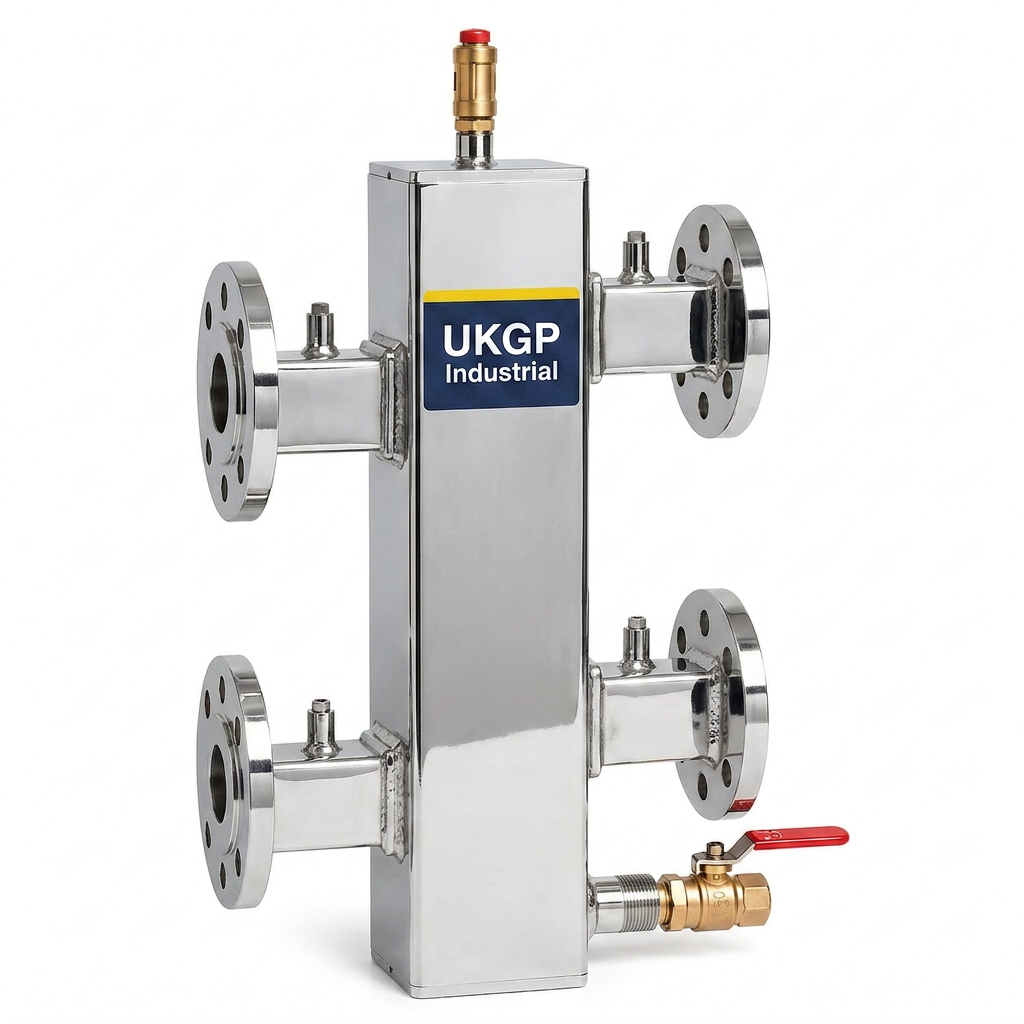
- No. Dosing pots are designed for adding chemicals. While they can be used to bleed small amounts of air, they are not a replacement for dedicated degassers or air and dirt separators.
Is a floor drain required near the dosing pot?
- It is best practice to install the dosing pot in a plant room location with a floor drain. If a leak or splash occurs during filling, it ensures chemicals do not damage floor finishes or enter electrical risers.