The 2-Litre Dosing Pot: Precision for Small-Scale Systems
The 2-litre dosing pot is the smallest standard size and is primarily utilised in low-volume systems or specific zones within a larger building. In modern, high-efficiency plant rooms with low-water-content boilers and thin-wall radiators, the total system volume can be surprisingly small. Here, a 2-litre unit prevents the risk of over-dosing, which can be as detrimental as under-dosing, particularly when dealing with sensitive aluminium heat exchangers.
From a practical installation perspective, the 2-litre unit is often chosen for its compact dimensions (typically around 114mm diameter). It is ideal for retrofitting into cramped secondary-side plant rooms where wall space is at a premium. Engineers must ensure that even with this smaller capacity, the pot includes the mandatory safety features: Tundish, check valves, and non-return valves to comply with water regulations.
- Minor expansion loops or small commercial units.
- Individual branch lines where local dosing is required.
- Systems with a total water volume under 2,000 litres.
- Plant rooms with severe footprint restrictions.
5 and 10 Litre Capacities: The Industry Standard
The 5-litre and 10-litre dosing pots are the 'workhorses' of the UK building services industry. Most inhibitor manufacturers specify a dosage rate of 0.5% to 1.0% of system volume. A 5-litre pot allows for a single-shot dose for a 1,000-litre system at a 0.5% concentration. In larger 5,000 to 10,000-litre circuits, the 10-litre pot balances the need for volume with the physical ease of manual handling. Chemical containers are typically sold in 5L or 10L drums, meaning these pot sizes align perfectly with standard product packaging.
When selecting between 5L and 10L, engineers should consider the 'slug-dosing' frequency. If a system requires frequent biocide additions, such as a chilled water loop prone to pseudomonas growth, a 10-litre pot reduces the number of fill-and-flush cycles the maintenance technician must perform. This not only saves time but reduces the introduction of fresh, oxygenated water into the loop—a key requirement of BSRIA BG29/21.
- Standard commercial LTHW systems (e.g., small schools or offices).
- Initial dosing of inhibitors in systems up to 5,000 litres.
- Mid-sized CHW systems requiring biocidal shock treatment.
15 and 25 Litre Pots: High-Volume Industrial Applications
For large-scale infrastructure, 15 and 25-litre dosing pots are necessary. These units are significantly heavier and require robust floor-mounting or heavy-duty wall brackets. They are typically specified for systems where the total volume exceeds 20,000 litres. The primary advantage of a 25-litre pot is the ability to introduce large volumes of chemical quickly, which is critical during the initial commissioning phase or after a major system drain-down.
However, engineers must exercise caution regarding the static weight and manual handling. A 25-litre pot, when full of liquid, represents a significant load. UKGP Industrial models are designed with this in mind, featuring ergonomic valve layouts to simplify the process. These larger pots are also frequently used for manual glycol top-ups where a dedicated glycol make-up unit (PU) is not installed, though this remains a labor-intensive method for maintaining antifreeze concentrations.
- District heating networks and large-scale industrial loops.
- Systems where glycol (antifreeze) requires manual adjustment.
- High-volume thermal stores and buffer vessels.
Technical Considerations for Specification
The selection process must start with a precise calculation of the total system volume, including all pipework, heat emitters, and thermal storage. Using a dosing pot that is too small for a large system results in 'dilution lag,' where the chemical is not distributed evenly, leading to localized corrosion cells. Conversely, an oversized pot in a small system can lead to chemical wastage and potential damage to seals and O-rings if concentrations exceed recommended limits.
Furthermore, the dosing pot should never be viewed in isolation. To meet BSRIA BG50 standards, the pot must be installed alongside high-efficiency air and dirt separators. While the dosing pot introduces the 'cure,' the separator removes the 'cause' of many hydronic issues. Combining a UKGP Industrial dosing pot with a high-velocity dirt separator ensures that the chemicals added can effectively coat clean internal surfaces rather than reacting with suspended magnetite or debris.
- System Volume (m³): The fundamental metric for chemical calculation.
- Dosing Method: Manual slug-dosing vs. bypass dosing.
- Chemical Concentration: Check the manufacturer’s SDS for the required percentage.
- Maintenance Access: Ensure clearance for chemical pouring via the tundish.
Material Integrity and Compliance Standards drowned
In the UK, dosing pots must be manufactured to high standards to withstand the thermal and pressure stresses of a plant room. UKGP Industrial dosing pots are typically fabricated from stainless steel, ensuring that the pot itself does not become a source of corrosion. Carbon steel alternatives, while cheaper, are susceptible to internal pitting, particularly when biocides are introduced in concentrated shots.
Compliance with the Pressure Equipment Directive (PED) and relevant British Standards is essential. A failure in a dosing pot is a failure of the entire system's integrity. For facilities managers, ensuring the dosing pot is fitted with a secondary isolation valve and a clear flow indicator can significantly improve the safety of the chemical introduction process. Always verify that the pot includes a 1/2" or 3/4" BSP connection for integration into the bypass line.
- Fabrication: Stainless steel (304 or 316) is preferred over carbon steel to prevent pot corrosion.
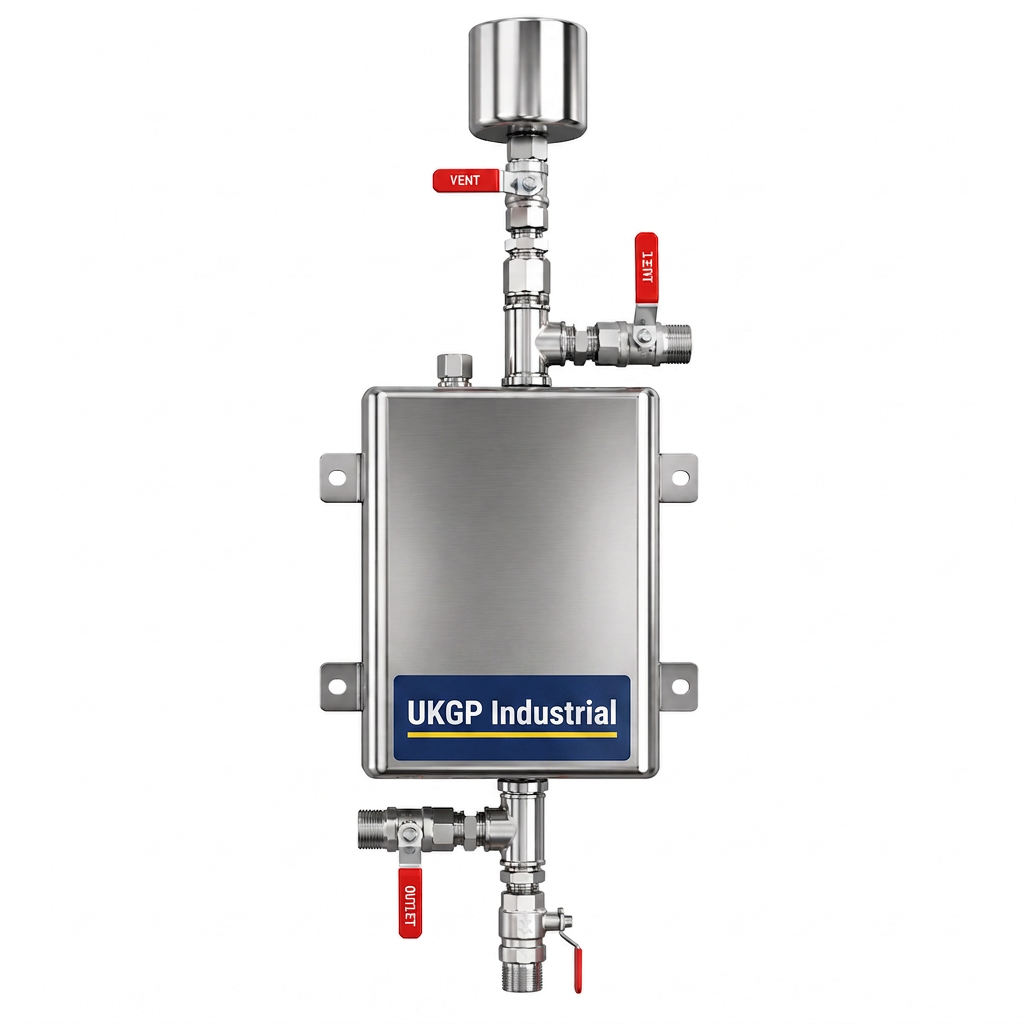
- Valving: Must include inlet, outlet, drain, and air vent valves.
- Safety: Integrated tundish and non-return valves are non-negotiable for WRAS compliance.
- Pressure Rating: Ensure the pot is rated for the system's maximum working pressure (typically 10 bar or 14 bar).
Installation and Best Practice for FM Teams drowned
Correct installation is as vital as correct sizing. The dosing pot should be installed as a bypass across the main flow and return headers. This creates a pressure differential that 'sweeps' the chemical into the system flow. If the differential pressure is insufficient, the chemical may sit stagnantly in the pot, leading to ineffective treatment and potential bacterial growth within the pot itself.
For Facilities Managers, regular inspection of the dosing pot's valves is a requirement of BG50. Leaking glands or seized valves are common issues that lead to air ingress. When the pot is not in use, it should be left drained or fully isolated to prevent it from becoming a dead-leg. Standardizing on UKGP Industrial units across a site portfolio ensures that maintenance teams are familiar with the operation and spare parts such as seals and air vents are interchangeable.
- Isolate the pot from the system.
- Drain the pot via the lower valve into a suitable container.
- Fill with chemical via the tundish.
- Close the fill and vent valves.
- Open the main isolation valves to sweep the chemical into the system.
Frequently asked questions
Is a chemical dosing pot a legal requirement under British Standards?
- No. While the dosing pot is the safest and most efficient method for manual slug-dosing, BS EN 12828 and BSRIA BG50 allow for other methods provided they ensure thorough mixing and do not introduce oxygen. However, for UK commercial plant rooms, dosing pots remain the industry standard for compliance and ease of use.
Where should the dosing pot be positioned in the plant room?
- Dosing pots should be installed across the main flow and return lines, typically on the primary side of the low-loss header or heat exchanger. They must be valved to allow for isolation without interrupting system flow. Correct orientation is essential to ensure the flow enters the top and exits the bottom to aid chemical dispersal.
Can I use a 25-litre dosing pot for glycol top-ups?
- Yes, but they are generally less efficient for glycol due to the volumes required. For systems requiring significant antifreeze concentrations (e.g., 25%–30%), a pressurised glycol make-up unit (PU) is the preferred method to maintain system pressure and concentration simultaneously.
What are the typical pressure and temperature ratings for commercial dosing pots?
- Standard dosing pots from UKGP Industrial are typically rated to 10 bar or 14 bar at 120°C. For high-rise or high-pressure process applications, bespoke units rated up to 25 bar may be required to meet the system's static head and pump pressure.