INDUSTRIAL INSTRUMENTATION & WATER TREATMENT

pH Sensor Temperature Compensation

Effective water treatment in UK commercial heating and cooling systems relies on precision pH monitoring. However, the electrochemical relationship within a pH probe is fundamentally dependent on temperature. For building services engineers and plant-room managers, understanding how to apply temperature compensation is critical to preventing scale, corrosion, and system degradation. This technical guide examines the Nernst equation, the practical application of M12 smart transmitters, and the integration of these sensors into modern Building Management Systems (BMS).

10 June 2026 6 min readpH sensor transmitters
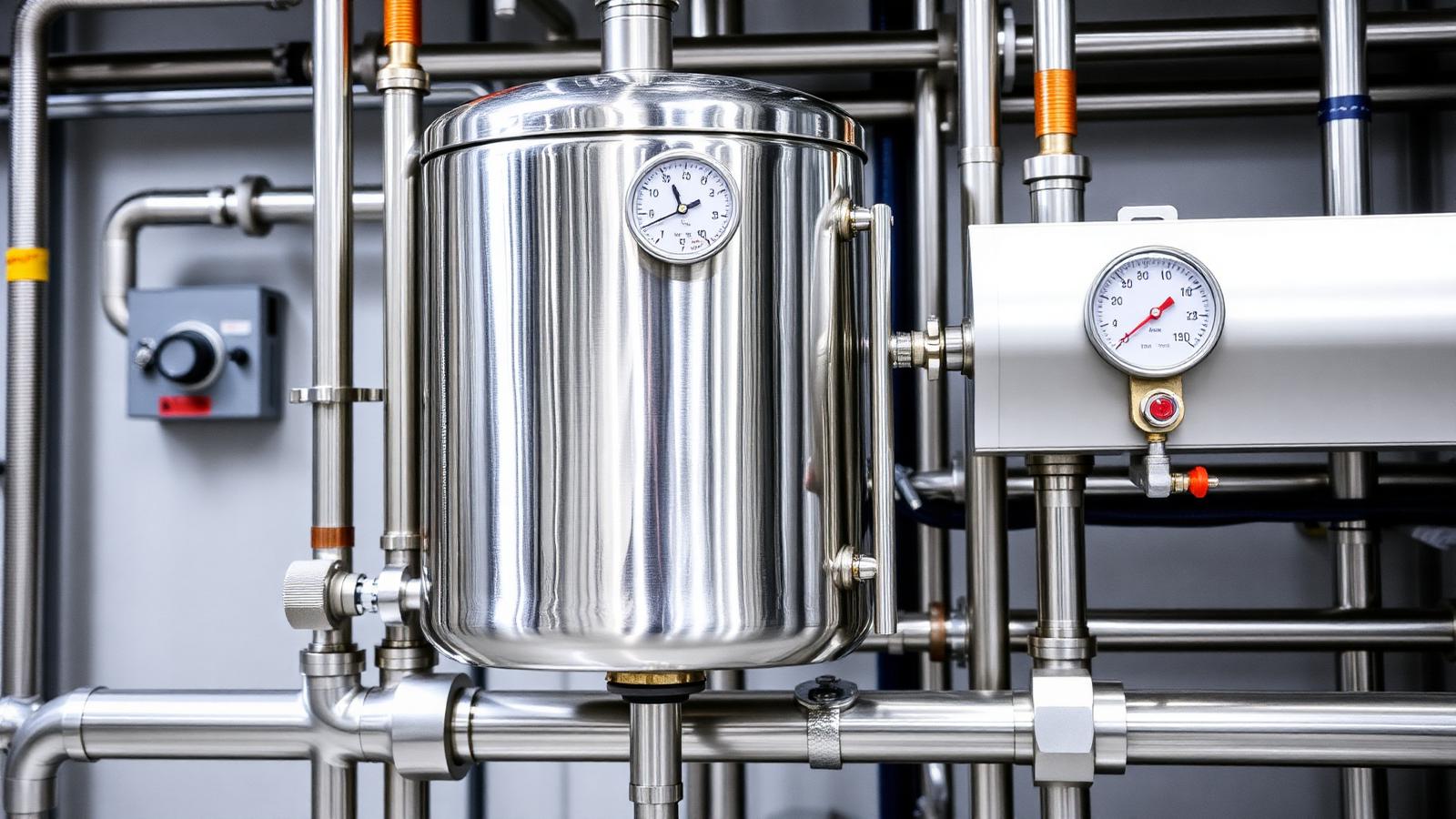
pH Sensor Temperature Compensation — Industrial pH sensor and transmitter installed on process pipework
Industrial pH sensor and transmitter installed on process pipework

The Physics of Temperature Dependence

To maintain closed-loop water quality, engineers must account for the Nernstian slope. A standard pH electrode produces a millivolt (mV) signal that varies according to the hydrogen ion concentration. At the neutral point of 7.00 pH (the isopotential point), the temperature has negligible effect on the voltage output. However, as the pH deviates from neutral, the temperature-induced error becomes significant.

In a typical UK plant room, where primary heating circuit temperatures can reach 80°C and chilled water circuits can drop to 4°C, a sensor calibrated at 25°C will provide false readings if not compensated. For example, at pH 10.0 and 80°C, an uncompensated probe could report a value of 9.4 pH, leading to unnecessary chemical dosing and potential damage to aluminium heat exchangers.

  • The Nernst Equation: E = E0 - (RT/nF)ln(Q).
  • Voltage output increases linearly with absolute temperature.
  • The 'Slope' of the sensor changes by 0.03 pH per 10°C per pH unit away from pH 7.0.

Frequently asked questions

What is the difference between ATC and manual temperature compensation?

Automatic Temperature Compensation uses a PT100/PT1000 element within the probe to adjust the Nernstian slope in real-time. Manual compensation requires the user to input a fixed temperature value into the transmitter, which is only suitable for processes with a constant, stable operating temperature.

Is temperature compensation still required if my process is always near pH 7.0?

While pH 7.0 is technically the isopotential point (where temperature has no effect), accuracy still drifts as temperature rises. For heating systems or steam condensate monitoring, uncompensated readings can lead to significant errors in chemical dosing control.

How does cable length affect temperature-compensated pH readings?

Correct cabling is critical. For smart M12 systems, use double-shielded twisted pair cables to prevent EMI from VFDs or pumps. For traditional systems, keep high-impedance pH cables as short as possible and never run them in parallel with AC power lines.

How much error does temperature actually introduce?

At 25°C, one pH unit equals 59.16 mV. At 80°C (typical for a heating primary circuit), this increases to approx 70 mV. Without compensation, the transmitter will incorrectly calculate the pH value.
Keep reading

Related articles

pH sensor transmitters

Industrial pH Sensor Transmitters in Plant Room Engineering

For building services engineers managing large-scale HVAC, cooling terminals, or industrial effluent, pH monitoring is the first line of defence against asset degradation. A pH sensor is more than a simple probe; in a modern plant room context, it is a precision electrochemical instrument that converts chemical activity into a standardised electrical signal. This guide examines the mechanics of pH measurement, the transition toward smart M12 quick-connect electronics, and the critical role of pH monitoring in maintaining system longevity under BSRIA and CIBSE guidelines.

Read
pH sensor transmitters

Precision pH Measurement in Industrial Building Services

For building services engineers managing HVAC systems, cooling towers, and industrial wastewater, monitoring pH is not merely a box-ticking exercise; it is a critical safeguard against asset degradation and regulatory non-compliance. A drift in pH can lead to rapid pipework corrosion, scaling of heat exchangers, or the failure of chemical dosing regimes. Understanding the underlying electrochemistry of pH sensors, and the advantages of modern smart transmitters, is essential for maintaining system longevity and operational efficiency. This guide examines the mechanics of pH measurement, focusing on robust, industrial-grade solutions required for the UK plant room environment.

Read
pH sensor transmitters

Advanced Guidance: How to Use a pH Sensor in Industrial Systems

For the building services engineer, pH monitoring is the first line of defence against asset degradation. Whether managing a cooling tower, an industrial wastewater discharge, or a critical process loop, accurate pH measurement dictates the efficacy of chemical dosing and the longevity of heat exchangers. This technical guide examines the application of modern pH sensor transmitters, focusing on M12 digital electronics and the move away from high-impedance coaxial cabling toward robust, field-swappable smart technology.

Read
Request Quote